

Rwanda’s planned Formula 1 circuit in Bugesera will feature 17 corners, a straight stretching more than 1 kilometre, steep climbs, banked turns and high-speed sections running alongside a lake, in what its designers describe as a fast, flowing racetrack built around the country’s natural landscape.
The approximately 6-kilometre circuit, to be constructed near the new Kigali International Airport, about 40 kilometres south of Kigali, will form the centrepiece of the Formula 1 African Grand Prix, which is expected to begin in the early 2030s.
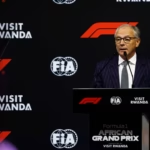
The project follows a 10-year hosting agreement announced in Kigali on Tuesday, October 13, marking Formula 1’s planned return to Africa for the first time since the 1993 South African Grand Prix.
Unlike circuits built on relatively flat land, the Bugesera track is being designed to follow the contours of 2 hills overlooking a lake, with 197 metres of cumulative elevation gain over a lap. The proposed anticlockwise layout will combine rapid descents, demanding climbs and corners with varying degrees of banking and camber.
Carsten Tilke, managing partner of Tilke Engineers and Architects, which is collaborating with former Formula 1 driver Alexander Wurz’s design company, said the terrain offers an opportunity to create an unusual racing experience.
“The drivers will love the track because it has so much elevation going up and down, high bankings,” Tilke told journalists in Kigali.
He said the circuit would be fast and flowing, with the surrounding hills providing natural spectator viewing areas and opportunities to bring fans close to the racing action.
The location was selected after the designers considered several alternatives, including a street circuit and a possible development around Kigali’s existing airport.
Wurz, who has been involved in the project for several years, said Bugesera’s landscape ultimately made it the preferred choice.
“It’s two hills with the lake below,” he explained in an interview published by Formula 1, describing a setting where the track could climb and descend through the landscape rather than impose an entirely artificial layout.
One of the circuit’s most important features will be a straight measuring more than 1 kilometre, followed by a heavy braking zone designed to encourage overtaking.
Such a configuration allows cars to reach high speeds before drivers brake sharply into a corner, creating opportunities to challenge rivals for position.
Tilke said the designers are paying particular attention to overtaking points and the possibility of different race strategies, recognising that a technically challenging circuit must also produce competitive racing.
The track will also feature combinations of fast corners near the lake, where drivers will need to maintain speed and precision while negotiating changes in direction.

“We go very close to the lake with fast corner combinations,” Tilke said, according to Reuters.
Another defining characteristic will be the use of banking and camber, which refer to the way a road surface is inclined through a corner.
These features influence tyre grip, vehicle balance and the speeds at which drivers can negotiate turns. Combined with the steep gradients, they could make Bugesera a demanding circuit for both drivers and engineers.
Wurz, who has completed thousands of simulated laps during the design process, compared the experience to a roller coaster.
The designers are also studying how Rwanda’s altitude and thinner air could affect vehicle aerodynamics, particularly downforce and drag, as they refine the circuit’s geometry.
The objective is to create a track that rewards driving skill while providing sufficient opportunities for overtaking, tyre management and alternative racing strategies
Beyond the racing surface, the circuit will incorporate a paddock complex designed to reflect Rwanda’s landscape and architectural identity.
The paddock, which accommodates racing teams, garages, technical operations, officials and hospitality facilities, is planned as a terraced development following the contours of the site.
Tilke said its design would draw inspiration from local villages and Rwandan culture, departing from the large, flat paddock layouts commonly associated with modern racing venues.
The hills surrounding the circuit are also expected to function as natural grandstands, offering spectators elevated views of multiple sections of the track. “We can bring the spectators very close,” Tilke said. The circuit will be developed to FIA Grade 1 standards, the highest level of international circuit certification required for Formula 1. That will involve extensive safety and operational infrastructure, including suitable runoff areas, barriers, medical facilities, race control, pit garages and emergency access.
However, the circuit has not yet been constructed or certified, and the complete corner-by-corner layout has not been publicly released.
The development is also intended to accommodate other motorsport disciplines and activities outside the Formula 1 calendar.
According to Formula 1, plans include karting facilities, off-road courses and a driving experience centre, providing opportunities for driver development, training and recreational motorsport.
The wider complex is expected to operate throughout the year, hosting other international motorsport events, conferences, exhibitions and entertainment activities.
This multipurpose approach is intended to generate commercial activity beyond the annual Grand Prix and support Rwanda’s broader ambitions in sports tourism, infrastructure development and investment.
President Paul Kagame said the agreement should be understood as a long-term investment rather than an arrangement to stage a single international sporting event.

“The circuit in Bugesera, alongside the new international airport, will bring jobs, skills, tourism and new business to our country and our region for decades to come,” Kagame said during the announcement.
He added that the ambition was to create lasting benefits for Rwandans while opening opportunities for young Africans to participate in motorsport as engineers, technicians, entrepreneurs and drivers.
Formula 1 President and CEO Stefano Domenicali similarly described the agreement as an opportunity to develop motorsport’s presence on a continent where the championship estimates it already has more than 100 million fans.
Rwanda Development Board CEO Jean-Guy Afrika said the choice of the name African Grand Prix reflects an ambition to make the event a continental occasion rather than one associated exclusively with Rwanda.
For now, significant elements of the project remain under development. The final circuit configuration, construction cost, detailed spectator arrangements and precise date of the inaugural race have not been announced.
What is already clear from the proposed design is the intention to create a racing venue whose defining characteristics come from the landscape itself.
With its steep climbs, high-speed lakeside corners, long overtaking straight, terraced paddock and natural viewing areas, Bugesera is being positioned as a distinctive addition to the Formula 1 calendar.
Whether those ambitions translate into a successful racing venue will depend on the final engineering, construction, safety certification and operational arrangements in the years ahead.