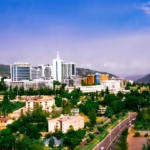


Not everyone was convinced when the International Automobile Federation (FIA) decided to bring its biggest annual gathering to Kigali in December 2024. Some resisted the move, questioned the destination and were reluctant to attend.
But FIA President Mohammed Ben Sulayem stood his ground, convinced that Rwanda deserved an opportunity.
Nearly two years later, that decision has helped pave the way for one of the most significant agreements in African motorsport history: a 10-year deal for Rwanda to host the African Grand Prix, bringing Formula 1 back to the continent for the first time since 1993.
Speaking alongside President Paul Kagame and Formula 1 President and CEO Stefano Domenicali in Kigali on Tuesday, October 13, Ben Sulayem recalled the resistance that accompanied the FIA’s initial engagement with Rwanda.
“We had a few people who were resisting it and trying not to come here, and I said to them, ‘You don’t know what you are missing.'”
He did not identify those who opposed the decision, but said the success of the FIA General Assemblies and awards ceremonies in Kigali became an important turning point.
The process, however, had begun much earlier.
Ben Sulayem explained that expanding motorsport in Africa had been one of his priorities since becoming FIA president in December 2021. He questioned why the continent had remained without Formula 1 racing for more than three decades and why the FIA’s presence in African motorsport was not stronger.
The opportunity to host the FIA General Assemblies in 2024 therefore became more than a ceremonial event. It allowed Rwanda to demonstrate its organisational capabilities while bringing together influential decision-makers from international motorsport.
The gathering also marked the first time the FIA General Assembly was held in Africa, during the federation’s 120th anniversary year.
Kagame opened the proceedings, participated in the awards ceremony and used the occasion to formally announce Rwanda’s bid to host a Formula 1 Grand Prix.
At the time, he thanked Domenicali for progress already made in discussions, indicating that negotiations were underway before the public announcement. “I assure you that we are approaching this opportunity with the seriousness and commitment which it deserves,” Kagame said on December 13, 2024.
There were also practical demonstrations of Rwanda’s ambitions.
During the FIA visit, Kagame inspected a low-cost cross-car prototype developed by Rwanda Polytechnic students using an FIA blueprint. The project demonstrated how cooperation could extend into engineering, manufacturing and technical education.
Ben Sulayem recalled Kagame’s involvement in the grassroots programme during Tuesday’s announcement, noting that the FIA had continued strengthening its partnership with Rwanda after the 2024 gathering.
“Since then, the FIA has not forgotten Rwanda and Africa; on the contrary, we have continued to strengthen our partnership and also turn our shared ambitions into concrete achievements,” he said.
One memorable episode involved Formula 1 world champion Max Verstappen, who visited a grassroots motorsport programme in Kigali during the 2024 awards event.
Verstappen had received a community service sanction from the FIA, and Ben Sulayem wanted the experience to benefit young motorsport enthusiasts.”We don’t need the money; what we need is public service,” he recalled.
He said Verstappen travelled directly from the airport to meet young Rwandan participants, speaking with them about motorsport and their ambitions.
Meanwhile, discussions about the Grand Prix continued behind the scenes.
The negotiations involved Rwanda’s government, the FIA and Formula 1 management, with Ben Sulayem and Domenicali playing important roles in bringing the different parties together.
Ben Sulayem suggested that cooperation between the FIA and Formula 1 leadership had improved during the process.
“The relationship is much, much better. We share a lot of thoughts,” he said, addressing Domenicali.
“Thank you for believing in Africa, thank you for believing in the leadership of the President, and thank you for making it happen also together.”
The FIA president also credited Kagame’s leadership and acknowledged the work of Rwanda’s negotiating team.
“Your team has been working very hard, and then you have a great minister here who I can see is a very good negotiator,” he said, without identifying the minister by name.
Rwanda was pursuing the agreement at a time when South Africa was also working to restore Formula 1 racing at Kyalami, which last hosted the championship in 1993.
Formula 1 management had repeatedly maintained that returning to Africa required the right partner, a sustainable project and a long-term commitment. Domenicali reinforced that position during Tuesday’s announcement.

“For many years, we have spoken about our desire to return. But we always said we would return in the right way. With the right vision and the right partner.” “That partner is Rwanda.”
The agreement will see the African Grand Prix, presented by Visit Rwanda, staged at a new purpose-built circuit in Bugesera, approximately 40 kilometres south of Kigali, near the new international airport.
The circuit, designed with the involvement of former Formula 1 driver Alexander Wurz and Tilke Engineering, is planned to accommodate approximately 100,000 spectators and meet FIA Grade 1 requirements.
Although the hosting agreement covers 10 years, the inaugural race is expected in the early 2030s, subject to construction and certification of the circuit. The financial terms, including hosting fees and the total infrastructure budget, have not been disclosed.
Kagame said the agreement reflected a shared conviction that Africa could play a greater role in international motorsport and retain more economic value from global sporting competitions.
“What brought us together is a shared conviction that Africa has the potential to elevate the quality of motorsport as a global and elite discipline,” he said.
He added that the partnership should generate opportunities in tourism, hospitality, entertainment and infrastructure development, while helping African countries become active participants in the global sports economy.
Ben Sulayem also explained the significance of naming the event the African Grand Prix rather than the Rwanda Grand Prix.
“Just look at the name here: it’s not selfish, it’s not called Rwanda F1, it’s called Africa. This is sending a message; it is about Africa.”
The FIA president expressed confidence that Rwanda’s inclusion would receive the necessary support from the federation’s World Motor Sport Council, while promising continued technical assistance before the first race.
He said the FIA would remain involved in grassroots racing, affordable karting, technical education and training rather than wait for the Grand Prix to begin.
For Kagame, the agreement was also an opportunity to encourage other African countries to pursue major international motorsport events.
“Ultimately, what we want is for the African Grand Prix to pave the way for other races to be hosted on the continent. This is not impossible to achieve, and what we are doing now proves this.”
As the ceremony moved towards its conclusion, Kagame assured Formula 1 and the FIA that Rwanda would honour its commitments. “I can assure you that you have a trusted and reliable partner in us.”
The announcement then gave way to a promotional video celebrating the arrival of Formula 1 in Africa, with a message inviting the world to Kigali.
For Rwanda, the agreement is the outcome of years of discussions, relationship-building and preparations. What began with a contested decision to bring the FIA’s annual gathering to Kigali has now developed into a decade-long commitment to international motorsport.
The next phase will involve turning that agreement into a functioning racing circuit, a trained workforce and an international sporting event capable of delivering benefits well beyond the Grand Prix weekend.
Sources for the additional historical and technical details: Formula 1’s official announcement and Kagame’s December 2024 FIA address.