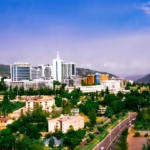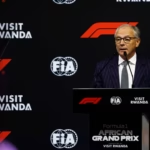


Rwanda’s landmark Formula 1 agreement has unveiled ambitions that extend far beyond bringing the championship back to Africa after more than three decades. From a potential global debut of new V8 engines and a record-breaking circuit to multimillion-dollar investments, local manufacturing and opportunities for young Africans, President Paul Kagame, FIA President Mohammed Ben Sulayem and Formula 1 CEO Stefano Domenicali revealed significant details about the future of motorsport. Here are 10 key takeaways from their remarks in Kigali on October 13, 2026.
1. Formula 1’s new V8 engine could make its global debut in Rwanda
FIA President Mohammed Ben Sulayem revealed plans to introduce a new V8 engine around 2030, potentially coinciding with Rwanda’s inaugural Grand Prix. He suggested that the new generation of cars could be approximately 80 kilograms lighter, while engine research and development costs could fall by at least 50 percent. “I’m positive that will be launched here,” he said.
The proposal remains an ambition rather than a confirmed technical regulation, but it could represent a major change in Formula 1’s future.
2. Africa returns to Formula 1 after more than three decades
Formula 1’s return to Africa will end an absence dating back to the 1993 South African Grand Prix at Kyalami. Rwanda has secured a 10-year hosting agreement, with the first African Grand Prix expected in the early 2030s. Formula 1 CEO Stefano Domenicali said the agreement would bring the championship to every inhabited continent. “Africa has always been part of Formula 1’s future,” he said.
3. Formula 1 chose Rwanda over other interested African countries
Domenicali confirmed that Formula 1 held discussions with several African countries before selecting Rwanda. He attributed the decision to Rwanda’s determination, the work of its negotiating team and the credibility of its long-term plans. He also suggested that the 10-year agreement could develop into a longer partnership. “We are talking about 10 years, but 10 years is just the beginning, because before arriving to 20 you need to pass through 10.”
4. Rwanda’s Formula 1 circuit could establish a new benchmark in track design


Presenter Naomi Schiff said the proposed circuit would run anticlockwise, following Bugesera’s natural landscape. She described the 197-metre elevation gain per lap as potentially record-breaking for the Formula 1 calendar. The final specifications remain subject to circuit development and approval.
5. Formula 1 sees Africa’s 100 million fans as a major growth opportunity
Domenicali said Formula 1 has more than 800 million fans worldwide, including over 100 million in Africa. He highlighted the continent’s growing young audience as an important opportunity for the championship’s commercial expansion. The African Grand Prix could strengthen Formula 1’s broadcasting, sponsorship, tourism and fan engagement activities across the continent.
6. Formula 1 expects major economic activity beyond race weekends
Domenicali said some Formula 1 events attract more than 400,000 attendees, generating business for host destinations. He emphasised the economic value of construction, tourism, hospitality, transport and employment during preparations and race weekends. The figure was a general reference to Formula 1 events, not a confirmed attendance projection for Rwanda.
7. FIA plans to make motorsport more affordable for African families
Ben Sulayem highlighted the high cost of competitive karting, saying some programmes can require between $200,000 and $250,000 per season. He said the FIA is developing more affordable karting programmes to widen access for young drivers. “Accessibility comes from affordability,” he said. The initiative could help African children enter motorsport without depending exclusively on substantial family wealth.
8. FIA wants Rwanda to manufacture racing karts and cross-cars locally
The FIA plans to support local production of motorsport equipment instead of relying entirely on imports. Ben Sulayem said FIA grants could help Rwanda manufacture karts and cross-cars, creating opportunities in engineering, fabrication and technical education. “Rwanda should not just import everything. You have the people,” he said.
9. Rwanda plans to train approximately 600 Formula 1 volunteers
Ben Sulayem disclosed that nearly 600 volunteers would require training to support the event. The FIA intends to assist with technical education, event management and motorsport operations. He also revealed discussions with Rwanda’s sports minister on preparing local personnel before the inaugural race. The objective is to develop expertise that can support future international events.
10. Kagame confirms private investors are participating in the Formula 1 project
President Paul Kagame revealed that the Grand Prix project is associated with substantial private-sector participation. “In fact, the effort is associated with a big private sector effort,” he said. He confirmed that some investors attended the announcement, while others were unable to be present. The identities of the investors, the financing structure and the total project cost were not disclosed in the speeches. Kagame also said Rwanda’s open-border policy was intended to make the country accessible to African visitors, workers and entrepreneurs who could benefit from the project. The central message from the announcement was that Rwanda intends to use Formula 1 not only to host an international race, but also to build a lasting motorsport industry with opportunities for the wider continent.
https://x.com/rbarwanda/status/2109954218375156213?s=20