






The Rwanda Development Board (RDB) has outlined a five-year strategic plan aimed at accelerating the country’s economic transformation by attracting investment, expanding exports and tourism, and strengthening the institution’s capacity to support businesses.
The RDB Five-Year Strategic Plan 2025–2030 is built around three strategic pillars: proactive sector growth, an enabling business environment, and institutional excellence.
The plan positions RDB as a key driver of Rwanda’s economic transformation, with a focus on identifying and supporting high-potential sectors capable of generating investment, jobs and increased economic activity.
Focus on investment and high-growth sectors
Under the first pillar, Proactive Sector Growth, RDB seeks to drive investment and growth in sectors with strong economic potential.
The strategy is expected to contribute to Rwanda’s National Strategy for Transformation (NST2) 2024–2029 targets, including mobilising US$4.6 billion in private investment.
The investment target forms part of a broader economic agenda that also seeks to increase Rwanda’s export earnings and strengthen the contribution of tourism to the national economy.
Making Rwanda easier to invest and do business
The second pillar, Enabling Business Environment, focuses on making Rwanda an increasingly attractive destination for investors and businesses.
According to the strategic plan, RDB aims to help make Rwanda “the easiest place to invest and grow in Africa”, placing emphasis on improving the business environment and supporting companies throughout their investment and growth journey.
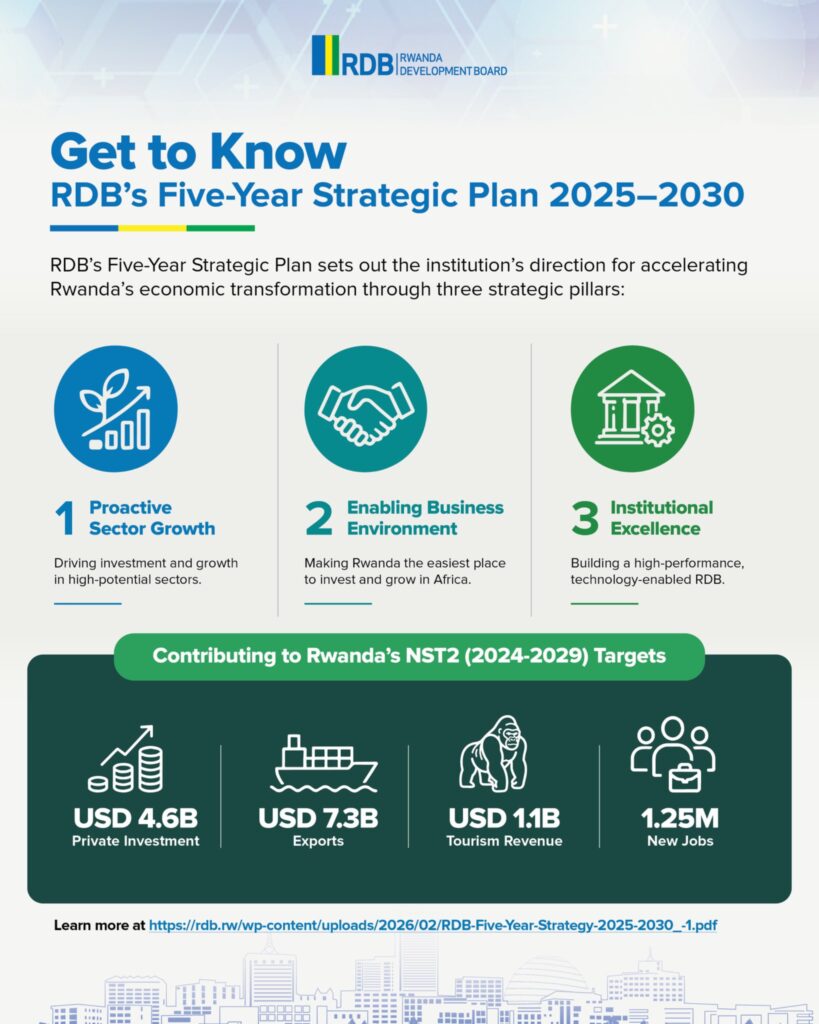
The strategy links this objective to an NST2 target of generating US$7.3 billion in exports, reflecting Rwanda’s ambition to expand its participation in regional and international markets.
Tourism remains a major economic priority
Tourism is another major component of the targets associated with the strategy.
Rwanda is targeting US$1.1 billion in tourism revenue under the NST2 period. RDB’s mandate in tourism includes promoting Rwanda as a destination while supporting the development of tourism products and investment opportunities.
The target comes as Rwanda continues to position tourism—including wildlife, conservation, conferences and other visitor experiences—as an important source of foreign exchange and economic activity.
1.25 million new jobs targeted
Employment creation is also central to the broader targets supported by RDB’s strategy.
The NST2 targets highlighted in the plan include the creation of 1.25 million new jobs, linking investment and private-sector expansion with increased employment opportunities.
By encouraging investment in high-potential sectors and supporting businesses to scale, the strategy seeks to connect economic growth with job creation.
Building a technology-enabled RDB
The third pillar, Institutional Excellence, focuses internally on strengthening RDB itself.
The plan seeks to build a high-performing, technology-enabled institution capable of delivering services more efficiently and responding to the changing needs of investors, businesses and other stakeholders.
This pillar is intended to strengthen RDB’s institutional capacity while supporting the effective implementation of the first two pillars.
5-year roadmap for economic transformation
Overall, the 2025–2030 RDB Strategic Plan provides a five-year framework for the development board’s contribution to Rwanda’s economic transformation.
Its three pillars—sector growth, business-environment enhancement and institutional excellence—are aligned with wider national targets covering investment, exports, tourism and employment.
If achieved, the targets associated with the strategy would see Rwanda mobilise US$4.6 billion in private investment, generate US$7.3 billion in exports, earn US$1.1 billion from tourism and create 1.25 million new jobs during the NST2 period.
The strategy therefore places RDB at the centre of efforts to translate investment opportunities and private-sector growth into measurable economic outcomes for Rwanda.