


Rwanda’s next phase of economic transformation will depend on more than attracting investors. It will require factories to become operational, local companies to enter global markets, tourists to spend more, and young people to secure productive jobs.
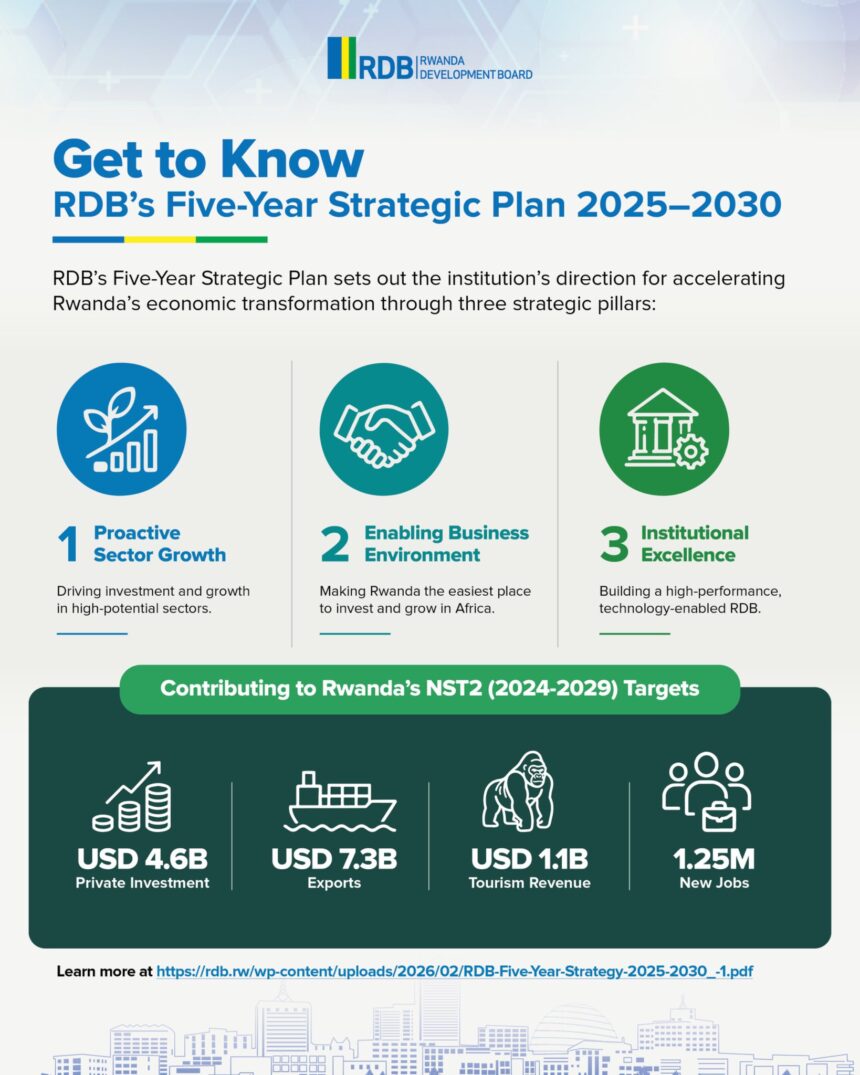
That is the central proposition of the Rwanda Development Board’s Five-Year Strategy for 2025–2030, released on Thursday, which translates the Second National Strategy for Transformation, NST2, into specific investment, export, tourism and employment targets.
Rwanda wants private investment to reach US$4.6 billion, exports to rise to US$7.3 billion and annual tourism receipts to climb to US$1.1 billion by 2029.
The three monetary targets total US$13 billion. The additional figure of 1.25 million refers to new jobs and cannot be counted as US$1.25 billion.
Even the US$13 billion is not a single financing package. Investment, exports and tourism receipts are different economic flows, with possible overlap between tourism and service exports. The total is useful mainly for illustrating the plan’s scale.
The Ministry of Finance and Economic Planning reported that Rwanda’s economy grew by 9.4 percent in 2025, outperforming the original 7 percent projection. GDP at current prices reached Rwf23.387 trillion. The IMF estimates Rwanda’s 2025 nominal GDP at approximately US$17.34 billion.
On that basis, RDB’s three financial targets are equivalent to about 75 percent of Rwanda’s current annual economic output. This does not mean US$13 billion will be added directly to GDP, but it demonstrates the magnitude of activity Rwanda wants to mobilise.
The targets are not starting from zero. In 2025, Rwanda registered US$2.62 billion in investment commitments across 799 projects, compared with 612 projects in 2024. The projects are expected to create more than 38,000 jobs, with real estate, manufacturing and mining attracting the largest shares.
Tourism generated US$685 million in 2025, up 6 percent from US$647 million the previous year. Visitor arrivals increased by 9 percent to 1.49 million. The meetings and conferences segment generated US$94.7 million from 165 events, while total export receipts reached US$3.6 billion, according to RDB’s 2025 performance report.
The new strategy seeks to accelerate this momentum through three connected pillars: proactive sector growth, an enabling business environment and institutional excellence.
RDB has identified eight priority sectors: tourism, agro-processing, mining, textiles and garments, transport and logistics, life sciences, digital services and financial services.
The approach is to move Rwanda towards higher-value economic activity. Instead of exporting mainly raw coffee, tea and minerals, the country wants more processing, refining and manufacturing to happen locally.
The frontier sectors are more futuristic. Rwanda wants to develop pharmaceuticals, vaccines, biotechnology, artificial intelligence, software, financial technology and business-process outsourcing.
Digital services are particularly attractive to a landlocked economy. A software developer in Kigali can serve an international company without requiring a container, seaport or expensive freight corridor.
Transport and logistics are also central to the plan. Bugesera International Airport, RwandAir’s cargo operations, cold-chain facilities, warehouses and digital border systems are expected to help position Rwanda as a regional distribution centre.
Across the eight priority sectors, RDB is targeting at least US$3 billion in real private investment, US$4.3 billion in exports and 250,000 productive jobs by 2029.
But selecting promising sectors will not be enough. Investment projects frequently stall over land, licences, utilities, taxation and approvals from different institutions.
RDB therefore plans to introduce a “greenlighting” system under which strategic projects receive accelerated approvals and dedicated account managers. At least 70 percent of priority projects should become operational within six months of registration.
That distinction is important. Registered investment represents intention. Only an operational business creates products, exports, salaries and taxes.
Routine investor services will increasingly move online through a unified portal. RDB wants all key investor-facing services to become digitally accessible by 2029 and processing times for startup and certification procedures to fall by 50 percent within two years.
The plan also proposes automated internal workflows, real-time performance dashboards and quarterly reviews. This is what makes the strategy coherent: priority sectors determine where growth should come from, business reforms remove obstacles, and institutional modernisation strengthens delivery.
The plan, however, is not RDB’s responsibility alone. Energy, infrastructure, education, taxation, immigration and regulation are controlled by different institutions. Success will depend on coordination across government and genuine cooperation with the private sector.
For a farmer, delivery should mean selling produce to a local processor instead of exporting it raw. For a graduate, it should mean a job in technology, biotechnology, finance, logistics or manufacturing. For an investor, it should mean that Rwanda can turn a registered commitment into an operating business.
RDB is attempting to evolve from a promoter of Rwanda into an architect of its next economy. That is the paradigm shift demanded by NST2. The decisive test will be execution.