

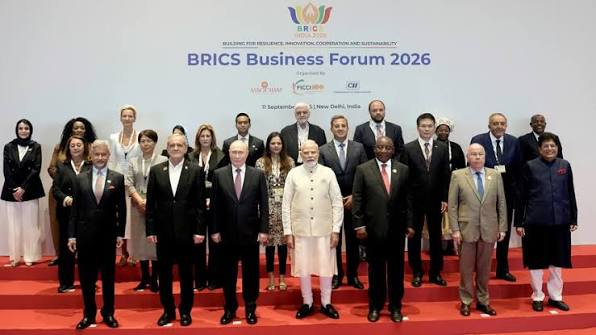
BRICS leaders have adopted the New Delhi Declaration, outlining plans to strengthen the influence of developing countries in global politics, finance, trade and technology.
The declaration was issued during the 18th BRICS Summit, held in New Delhi from September 12 to 13 under the theme, “Building for Resilience, Innovation, Cooperation and Sustainability.”
The bloc called for reforms of the United Nations Security Council, the International Monetary Fund, the World Bank and the World Trade Organization.
It wants Africa, Asia and Latin America to receive greater representation in institutions whose leadership and voting structures remain largely shaped by the post-Second World War order.
BRICS also agreed to advance faster and cheaper cross-border payments and promote trade and investment using members’ local currencies. However, the declaration did not create a common BRICS currency or provide a deadline for establishing a unified payment system.
The leaders backed an expanded role for the New Development Bank, including more local-currency financing for infrastructure and development projects.
They also supported further work on a proposed BRICS Grain Exchange, financing guarantees for projects and improved access to working capital for small and medium-sized businesses.
Artificial intelligence emerged as a major priority, with BRICS seeking greater access to AI resources for developing countries and cooperation in digital infrastructure, cybersecurity, healthcare, agriculture, education, manufacturing and energy.
The bloc also called for fairer critical-mineral supply chains that allow resource-rich countries to retain ownership and undertake more local processing.
On international security, BRICS supported an independent Palestinian state based on the 1967 borders, demanded humanitarian access to Gaza and called for negotiated settlements in Sudan, Lebanon and Syria.
It also reiterated support for African-led responses to conflicts on the continent.
Although politically ambitious, many of the declaration’s proposals remain voluntary or under technical discussion.
Their impact will depend on whether member countries provide financing, agree on operational structures and translate the commitments into working programmes.