


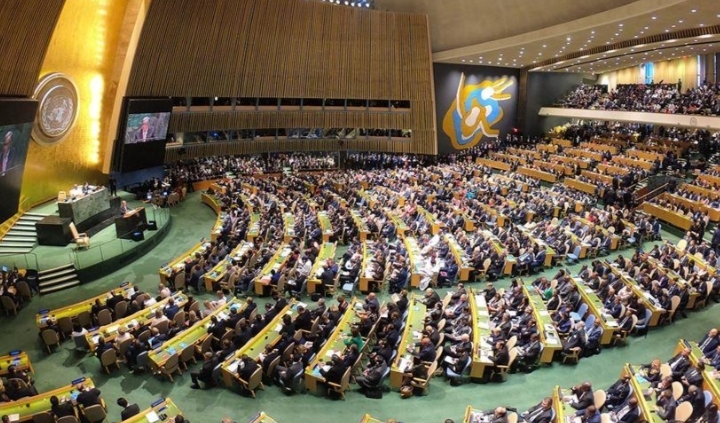
Todays world is fundamentally different from that of 1945 and the current realities require international system to evolve accordingly.
Economic influence has shifted, developing countries are increasingly important drivers of global growth, technology has transformed societies, and entirely new governance challenges have emerged.
China wants to overhaul the way things are done and recalibrate to existing realities through its Global Governance Initiative (GGI).
China has outlined nine directions for global governance reform.




The proposed reforms include improving UN efficiency, strengthening the Security Council, adapting peacekeeping operations to contemporary realities, placing development back at the centre of the international agenda.
They also include reforming global economic and financial institutions, establishing rules for artificial intelligence, strengthening governance of cyberspace and outer space, and promoting dialogue among civilizations.
These priorities address some of the most urgent governance gaps facing the world.
Artificial intelligence is a particularly important example. AI offers extraordinary opportunities for productivity, healthcare, education, scientific research and economic development.
However, it also raises difficult questions about security, employment, inequality and military applications.
No country can govern such a transformative technology entirely on its own.
The GGI’s call for international AI governance based on a people-centred, AI-for-good approach therefore provides an important platform for cooperation while seeking to prevent the digital divide from widening.
There are also signs of the initiative moving from principles towards implementation.
The commencement of operations by the International Organization for Mediation and new international cooperation mechanisms around artificial intelligence and data are examples of translating global governance ideas into practical institutions.
The GGI also builds upon China’s wider international cooperation architecture, including the Belt and Road Initiative.
Through this initiative alone, China has established cooperation frameworks with more than 150 countries and over 30 international organisations.
Together, these initiatives demonstrate China’s increasingly active contribution to shaping solutions to shared global challenges.
For the Global South, the opportunity is particularly significant. Developing countries should not merely receive decisions made elsewhere.
They should participate fully in establishing the rules governing trade, finance, technology, climate, development and international security.
A governance system that listens to more countries is not only fairer; it can also be more legitimate and effective.
At a time of growing fragmentation, the world needs mechanisms that bring countries together rather than divide them into competing blocs.
Sovereign equality, dialogue, respect for international law and shared development provide a constructive foundation for doing so.
That is ultimately why China’s Global Governance Initiative matters.
Its success should be measured by how it helps produce stronger institutions, greater representation for developing countries and practical solutions to common challenges.
The future of global governance cannot be designed by a few for the many. It must be shaped collectively.
By putting reform, representation, multilateralism and action at the centre of the conversation, China’s Global Governance Initiative offers a timely and positive framework for building a more just, inclusive and cooperative international order.
Global Governance Initiative (GGI)
On September 1, 2025, China’s President Xi Jinping proposed to the United Nations a Global Governance Initiative anchored on five core principles: sovereign equality, international rule of law, multilateralism, a people-centred approach and a commitment to real action.
However, the GGI does not seek to discard the existing international system or replace the United Nations with parallel structures.
Instead, China has consistently presented it as an effort to strengthen the UN-centred multilateral system and reform global institutions so they can respond more effectively to contemporary challenges.
According to China’s Foreign Ministry, nearly 160 countries and international organisations have supported or responded positively to the initiative. More than 60 countries have joined the Group of Friends of Global Governance, with platforms established in New York, Geneva and Vienna.
This growing participation demonstrates that reform of global governance is not simply a Chinese concern.
It reflects a wider desire, particularly across the Global South, for an international system that gives developing countries a greater voice.
Africa in focus
African countries have long argued that their representation within major international institutions does not correspond to the continent’s population, economic potential or contribution to international affairs.
China’s proposals specifically call for greater representation for developing countries and for addressing what it describes as the historical injustice faced by Africa in the UN Security Council.
But representation alone will not solve the world’s problems. Institutions must also deliver results.
That is why perhaps one of the most compelling elements of the GGI is its emphasis on action.
International diplomacy too often produces declarations, resolutions and ambitious commitments that are inadequately implemented.
Developing countries increasingly question whether global institutions adequately reflect today’s distribution of population, economic power and political influence.
Africa, home to nearly one-fifth of humanity, continues to seek a stronger voice in decisions that shape its future.
The GGI seeks to narrow this gap by making practical action one of its defining principles.
Author is Elijah Mwangi, scholar based in Nairobi. Commentator on local and global affairs.
Editor’s Note [Article has been reedited]