


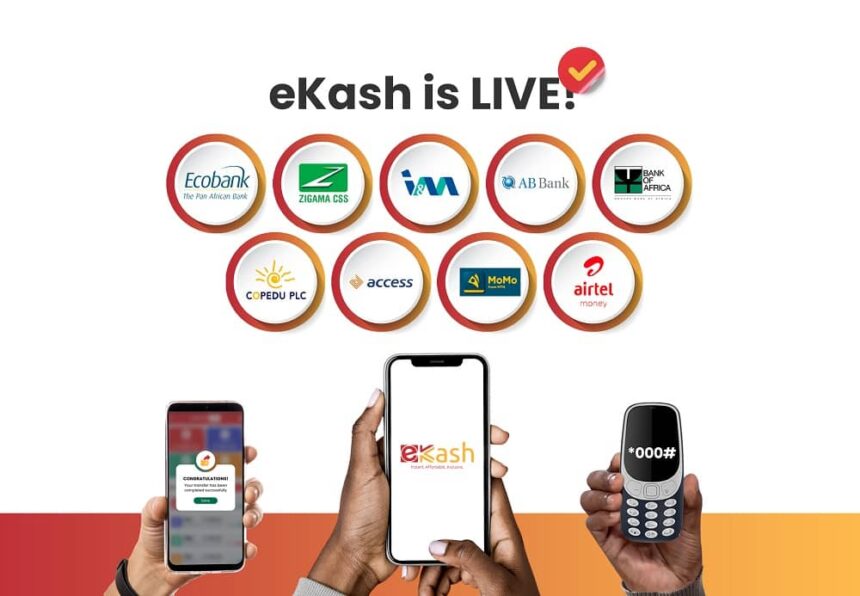
Rwanda has completed the transition of all domestic interoperable retail payment transactions to eKash, the Rwanda National Digital Payment System (RNDPS), marking a major milestone in the country’s efforts to build a more connected, efficient and financially inclusive digital economy.
The transition means that transfers between mobile money and banks are now processed through a single national interoperable payment infrastructure operated by RSwitch.
Since July 14, 2026, customers have been able to seamlessly transfer money between bank accounts and mobile wallets regardless of the financial institution they use.
The interoperable services include Account-to-Wallet, Wallet-to-Account, Account-to-Account and Wallet-to-Wallet transactions, allowing customers to move funds more easily across different financial service providers.
Under the new system, interoperable transactions processed through eKash attract a maximum fee of Rwf20 per transaction.
The fee applies only to transfers between different financial institutions and electronic money issuers, while existing on-net mobile money transactions remain governed by each operator’s existing tariff structure.
The Rwf20 charge is designed specifically to facilitate interoperability between different payment platforms and does not replace the existing tariffs applied for transfers within the same mobile money network.
Mobile money operators will continue maintaining their respective tariff structures for on-net transactions because they continue to invest in and operate their own infrastructure, including technology platforms, agent networks, customer support systems and the extensive efforts required to onboard and serve millions of users.
For example, transfers between two MoMo customers on the same network will continue to follow MoMo’s existing pricing model, while a customer transferring money from a MoMo wallet to a bank account or another mobile money network through eKash will pay the regulated interoperable fee of up to Rwf20.
The introduction of eKash also allows customers to pay merchants directly from their preferred bank account or mobile wallet, regardless of the financial institution that issued the merchant’s payment code.
This removes barriers between providers and creates a more unified digital payment environment.
The system supports transactions of up to Rwf10 million per transaction, although individual banks and electronic money issuers may apply lower limits depending on their internal risk management and operational policies.
Customers are not required to open new accounts, register for new services or download additional applications to use eKash.
Users can continue accessing payment services through existing USSD channels, mobile banking applications and internet banking platforms.
The rollout comes as Rwanda’s digital economy continues to expand rapidly.
According to RURA’s ICT Sector Statistics Report, mobile subscriptions reached 97.1 per 100 inhabitants in the first quarter of 2026, up from 94.8 a year earlier.
Mobile money adoption has also continued to grow, with active mobile money accounts increasing by 15.1 percent to reach 8.56 million, raising penetration to 59.4 accounts per 100 inhabitants.
The report further shows increased reliance on digital communication services, with national voice traffic growing by 19.4 percent year-on-year to 14.6 billion minutes, reflecting the expanding role of digital technologies in Rwanda’s economy.
By creating a single interoperable payment ecosystem, eKash is expected to make digital transactions faster, more affordable and more convenient while strengthening financial inclusion.
The system is also expected to increase competition among financial service providers and support Rwanda’s ambition of becoming a leading cash-lite economy through seamless digital payments.