

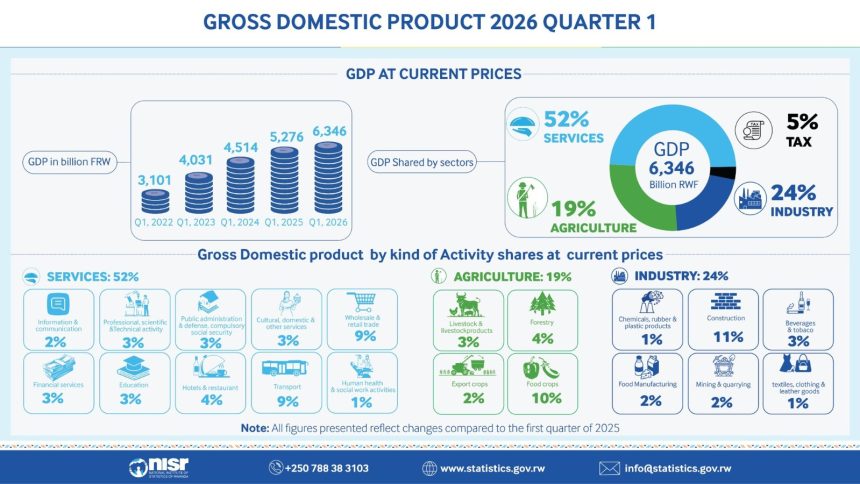
Rwanda’s economy recorded a strong start to 2026, with Gross Domestic Product (GDP) growing by 10% in the first quarter compared to the same period in 2025.
According to the National Institute of Statistics of Rwanda (NISR), GDP at current prices reached Frw 6,346 billion, up from Frw 5,276 billion in Q1 2025, demonstrating sustained economic expansion and increasing productivity across key sectors of the economy.
This impressive performance reflects Rwanda’s continued economic transformation, driven by a rapidly expanding services sector, growing industrial activities, and a resilient agricultural base.
The broad-based nature of this growth highlights the country’s efforts to diversify its economy and strengthen long-term development foundations.
Over the past five years, Rwanda has experienced steady economic growth.
GDP increased from Frw 3,101 billion in Q1 2022 to Frw 4,031 billion in Q1 2023, then rose to Frw 4,514 billion in Q1 2024, before reaching Frw 5,276 billion in Q1 2025 and Frw 6,346 billion in Q1 2026. This upward trend underscores the country’s resilience and its ability to sustain economic momentum despite global economic uncertainties.
The services sector remained the largest contributor to the economy, accounting for 52% of total GDP. Growth in this sector was primarily driven by wholesale and retail trade, transport, hotels and restaurants, financial services, education, and other professional activities.
Wholesale and retail trade, together with transport services, each contributed 9% to GDP, while hotels and restaurants contributed 4%. Financial services, education, public administration, professional and technical activities, and cultural and domestic services each accounted for 3%.
Information and communication contributed 2%, while human health and social work activities contributed 1%.
The continued expansion of the services sector reflects increasing urbanization, stronger domestic demand, improved connectivity, and the growing role of Rwanda as a regional hub for trade, tourism, and business services.
The industry sector contributed 24% of GDP, reinforcing Rwanda’s ongoing industrialization efforts.
Construction emerged as the largest industrial activity, accounting for 11% of GDP, driven by significant investments in infrastructure, housing, and commercial developments.
Other important industrial activities included beverages and tobacco production (3%), food manufacturing (2%), mining and quarrying (2%), chemicals, rubber and plastic products (1%), and textiles, clothing and leather products (1%).
The strong performance of industry demonstrates Rwanda’s commitment to expanding local production, increasing value addition, and reducing dependence on imports while creating employment opportunities.
Meanwhile, agriculture contributed 19% of GDP, reaffirming its importance to livelihoods, food security, and rural development.
Food crops remained the largest agricultural activity, contributing 10% to GDP, followed by forestry at 4%, livestock and livestock products at 3%, and export crops at 2%.
Although agriculture’s share of GDP is lower than services and industry, it remains a vital pillar of Rwanda’s economy because a large proportion of the population depends on agriculture for employment and income generation.
Net taxes accounted for the remaining 5% of GDP, reflecting government revenue collected through taxes on goods and services after deducting subsidies.
These revenues support public investments in infrastructure, healthcare, education, and social protection programmes.
Overall, the Q1 2026 results highlight Rwanda’s continued progress toward building a diversified, resilient, and inclusive economy.
The strong first-quarter performance positions the country well to sustain growth throughout 2026, create jobs, boost exports, attract investment, and accelerate progress toward its long-term development goals, including the aspirations outlined in Vision 2050.
While challenges such as global economic uncertainty, inflationary pressures, and climate-related risks remain, Rwanda’s broad-based economic growth provides a strong foundation for continued development.
The combination of a dynamic services sector, expanding industrial activities, and a resilient agricultural base signals that Rwanda is steadily advancing toward becoming a modern, knowledge-based, and middle-income economy.