

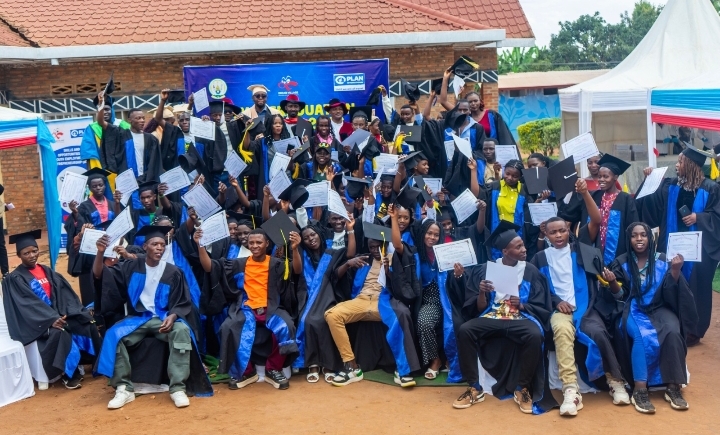
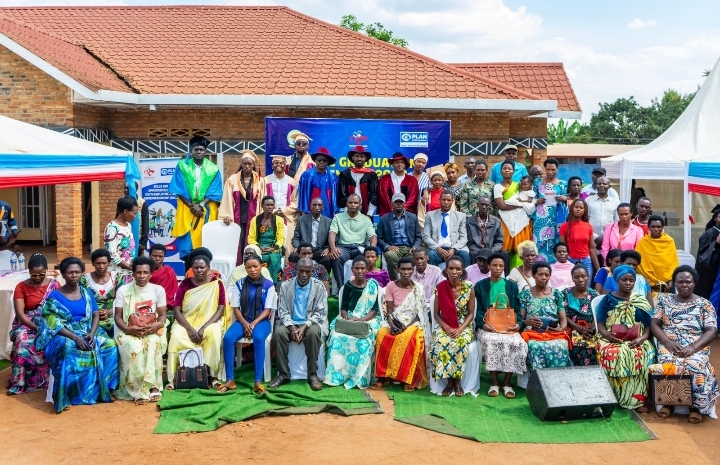
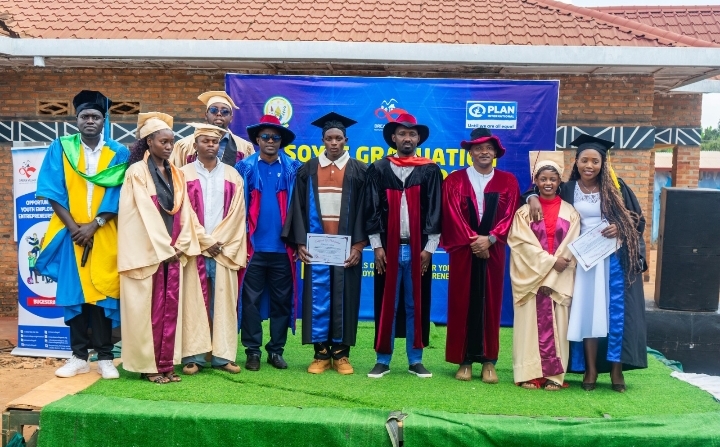
Under the blazing June sun in Gatsibo District, smiles outshone the heat as 49 young graduates proudly displayed products, innovations, and business ideas that only months ago seemed beyond their reach.
For many of them, this graduation was more than a ceremony. It was a second chance at life.
The graduates, most of whom are school dropouts, vulnerable youth, and teenage mothers, completed eight months of vocational and life-skills training through the Skills Opportunities for Youth Empowerment and Entrepreneurship (SOYEE) programme, implemented by Dream Village Rwanda in partnership with Plan International Rwanda.
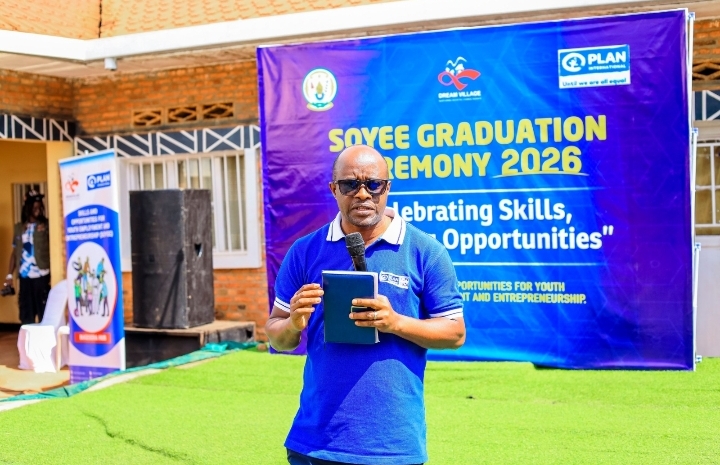

As family members applauded and community leaders looked on, the graduates showcased practical innovations in tailoring, hairdressing, and welding—demonstrating how skills training can become a powerful tool for social transformation and economic development in rural Rwanda.
Rebuilding Lives After Setbacks:
Of the 49 graduates, 35 are young women, many of whom dropped out of school after becoming pregnant as teenagers.
For Florence Mukeshimana, whose daughter Boaz Tuyishime dropped out of school at 17 and left school while in Senior Two, the graduation marked a deeply emotional turning point.
She remembers the shame, uncertainty, and social stigma that engulfed her family after her drop out.
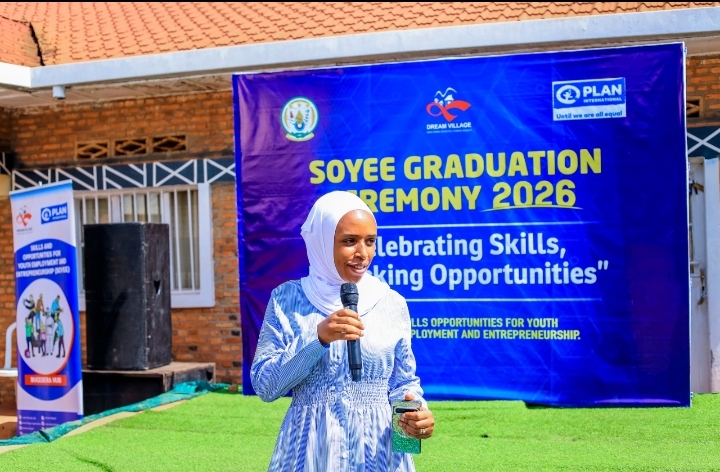

“We cried a lot as a family,” Mukeshimana recalls. “People mocked her, and she lost confidence. She had no income, and no hope for the future.”
Today, she sees a different person.
“My gratitude is on how this programme has changed our family life and wiped away my tears. My daughter is confident again, respected, and hopeful. That makes me proud.”
The transformation has inspired other families in the community. Mukeshimana says she has encouraged parents of other vulnerable girls to support vocational training opportunities after witnessing the positive impact on her own child.
First Cohort With Big Ambitions:
The graduates are the first SOYEE cohort in Gatsibo District, drawn from Kiziguro and Murambi sectors.
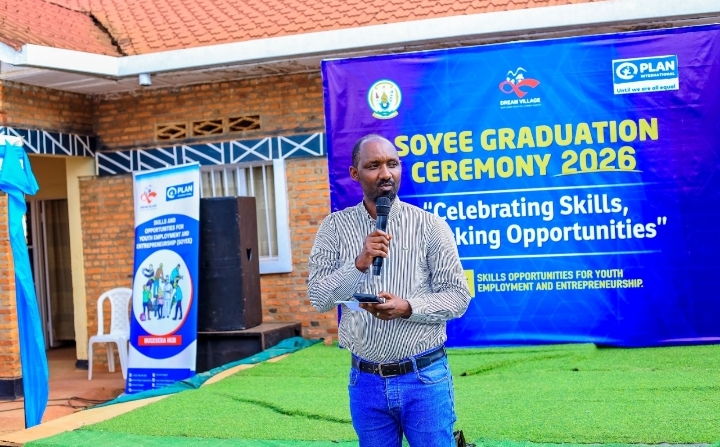
According to Leon Pierre Mupenzi, Gatsibo District Child Protection Officer, the programme has revealed untapped potential among vulnerable youth who were often overlooked.
“This is the first cohort graduation, but an incredible one,” Mupenzi said. “We have seen many innovations and creative minds among young people who had once lost hope but are now able to make a difference in their lives and society.”
His remarks carry particular significance in a district that continues to face challenges related to teenage pregnancy. Gatsibo is home to more than 2,000 teenage mothers, with fewer than 30 percent returning to formal education.
For district leaders, programmes such as SOYEE offer an alternative pathway to economic independence and social reintegration.
Innovation Born in Rural Communities:
What stood out during the graduation was not only the acquisition of vocational skills but also the level of creativity demonstrated by the graduates.

In the hairdressing section, trainees presented several hairstyles they believe can attract customers from across the district and reduce the need for women to travel to Kigali for specialized services.
Among them was the increasingly popular Boho hairstyle, locally adapted for rural customers, as well as “Jerry Curl” and “Pencil” styles that combine multiple braiding techniques.
One male trainee introduced a particularly unique concept: a detachable hairpiece stitched into a baseball cap.
The innovation allows women to wear the cap while displaying artificial hair at the back, creating a fashionable and affordable alternative to more expensive wigs.
“The style can last up to five years,” the trainee explained. “It is cost-effective and suitable for rural women.”
The graduates also demonstrated how affordable pricing—ranging between Rwf10,000 and Rwf25,000—can make professional hairstyling more accessible in rural communities.
For some trainees, the skills are already generating income.
“I used weekends to do hair for customers,” one female graduate said. “Before graduation, I had already earned Rwf35,000.”
Promoting Made-in-Rwanda Fashion
The tailoring graduates used the occasion to unveil clothing designs aimed at introducing new fashion trends in rural areas.
One design, called “Gentleman,” targets young men seeking modern yet affordable fashion.
Another collection, branded “Fine Girl,” features colorful kitenge fabrics designed to promote African fashion and locally made products.
Graduate Izabayo Sarah helped create a kitenge outfit paired with a matching round hat designed to protect wearers from the sun.
“No one makes designs like these in our area,” she said. “We want people in Gatsibo to enjoy the same fashion opportunities found in larger cities.”
Welding Solutions for Everyday Challenges:
Perhaps the most striking innovations came from the welding graduates, who focused on solving everyday challenges faced by rural households and small businesses.
Their showcase included a dual-purpose energy-saving stove that uses a single piece of firewood while reducing biomass consumption.
Priced at Rwf25,000, the stove can last between 10 and 15 years, offering a durable alternative to traditional clay stoves that often require replacement every few months.
“We are not just students; we are creators and innovators,” one graduate proudly declared.
The team also unveiled a flexible iron chair that converts into a staircase, allowing users to reach elevated spaces in homes and businesses.
Another innovation was a flexible bed system that can be rearranged to accommodate parents, children, newborn babies, or visiting relatives—an important feature for families living in limited spaces.
A multifunctional shop counter attracted particular attention. Designed for small business owners, the structure functions as a sales counter during the day and converts into a bed at night.
The graduates explained that the innovation can help traders operating from small premises reduce transport and accommodation costs while improving security by allowing them to remain close to their businesses.
Beyond Skills:
Dream Village Rwanda Programme Director Sylvia Ingabire says the initiative goes beyond vocational training.
“The programme is intended to create jobs, incomes, and empower youth in Rwanda,” she said.
Even in sectors such as welding, traditionally dominated by men, Ingabire noted growing participation from young women, demonstrating changing attitudes toward technical careers.
“We ask partners to continue supporting these graduates so they can create impact in society,” she added
SOYEE Project Manager Epimaque Utazirubanda reminded graduates that their journey is only beginning.
“You faced many challenges to reach this point,” he said. “But we believe in you and in your potential to succeed.”
Solving Entreprenuer’s Access to Finance:
One of the biggest barriers facing young innovators after graduation is access to capital.
To address this challenge, Plan International Rwanda announced plans to support the next phase of entrepreneurship development in Gatsibo.
According to Jacques Bakundukize, Plan International Rwanda’s Gatsibo District Program Unit Manager (PUM), the success of the first cohort has paved the way for a second intake scheduled for August 2026.
The organization has already secured Rwf1.5 million in loan guarantees and is mobilizing partners to support grants of up to Rwf10 million for promising business ideas developed by graduates.
The initiative aims to reach more than 300 young beneficiaries in the district.
Bakundukize also encouraged graduates to participate in the upcoming District’s Open Day activities beginning June 17, where they will have an opportunity to showcase their products and innovations to a wider audience.
For many of the graduates, however, the greatest achievement cannot be measured in financial terms.
It is the restoration of confidence, dignity, and purpose.
As Kiramuruzi Sector representative Yaum Uwagirase told the young women during the ceremony: “Use these new skills to create your own businesses and incomes. Change your lives and begin writing a new chapter.”
For the 49 graduates leaving the SOYEE training center, that new chapter has already begun—one innovation at a time.