




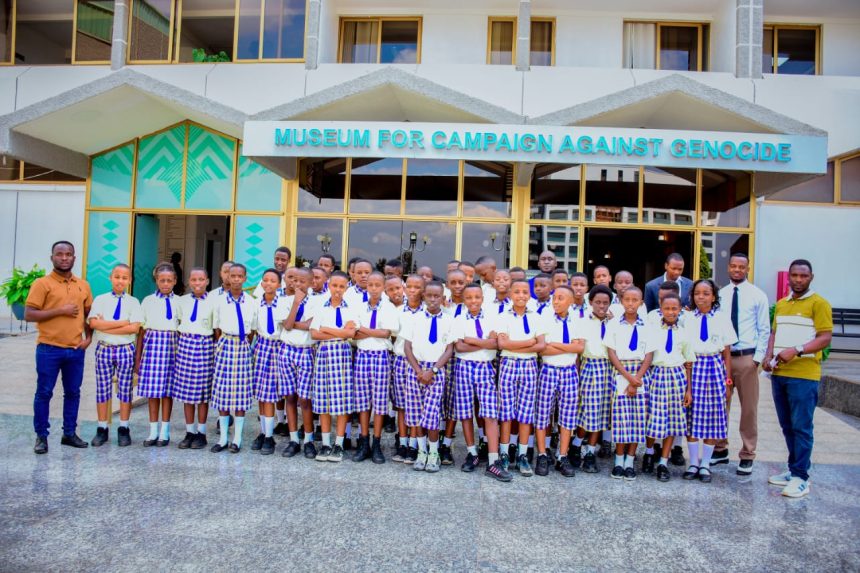
Thirty-nine students from Eden School in Huye District, Southern Province, visited the Museum of the Campaign Against Genocide in Kigali on Monday, June 16, 2026, as part of a field study aimed at deepening their understanding of Rwanda’s history and strengthening their sense of patriotism.
The museum, located within the premises of the Parliament of Rwanda in Kimihurura, documents the struggle to liberate the country and stop the 1994 Genocide against the Tutsi.
Accompanied by three teachers, the Primary Six students toured the museum and received detailed explanations from guides about Rwanda’s liberation journey, the events that led to the Genocide against the Tutsi, and the efforts made to rebuild the country.
School leaders said they intentionally chose this period of commemoration to help students reflect on Rwanda’s past, appreciate the country’s progress, and understand their responsibility in preserving the achievements made over the past three decades.
Promoting Practical Learning Beyond the Classroom
The Headteacher of Eden School, Jean Piere Mungwarakarama, emphasized the importance of experiential learning, saying modern education should go beyond theoretical classroom instruction.
“Today’s education is based on practical learning, not theory alone. Students need opportunities to move out of their comfort zones and learn directly from real-life experiences,” he said.
He explained that history is one of the key subjects taught in school, particularly Rwanda’s liberation struggle and the campaign to stop the Genocide against the Tutsi.
“Today, we brought the students here to learn first-hand information about the struggle to stop the Genocide, not just through textbooks but by witnessing history itself and learning from people who possess first-hand knowledge.”
He added that such visits help students understand the country’s history more clearly and equip them with values that will enable them to reject divisionism and prevent future tragedies.
“This helps students understand what really happened and strengthens their commitment to ensuring that Rwanda never returns to the destructive politics based on ethnicity and division.”
Students Reflect on Lessons Learned
For many students, the visit transformed historical lessons into a vivid and emotional experience.
Ikuzwe Hakimu Gwen, an 11-year-old Primary Six student, said the visit reminded them that stopping the Genocide marked the beginning of building a new Rwanda.
“We learn this history in class, but sometimes it is difficult to understand it clearly. Here, they explained everything to us, showed us photographs, and took us back to what Rwanda was like in 1994. My perspective has changed, and I almost feel like I was there.”
She said the experience would help her educate others.
“I will be able to explain this history in greater detail to my classmates and people in my community so that we can all fight against anything that could bring back such painful memories to our country.”
Another student, Abikunda Ntakirutimana Herve, 12, said he gained a deeper understanding of how the Rwanda Defence Force (RDF) stopped the Genocide and the importance of fighting harmful ideologies.
“Before coming here, our teachers taught us about stopping the Genocide, but here everything became more practical. We saw pictures, learned how it started, and understood how we can prevent it by rejecting divisionism.”
He added, “I will share everything I learned with my classmates who did not come. I will describe what we saw and explain the stories behind the photographs so they can also benefit from this experience.”
Teachers Also Benefit from First-Hand Learning
Teachers who accompanied the students said such visits are equally important for educators.
Kayitsinga Robert, a 29-year-old mathematics teacher, said field studies enable teachers to acquire deeper knowledge that improves classroom instruction.
“This is an excellent opportunity for students to learn directly from historical sources rather than relying entirely on theoretical lessons. Teachers, especially history teachers, should also visit and expand their knowledge so they can teach more effectively.”
He said the experience provided a clearer understanding of Rwanda’s history and the factors that contributed to the Genocide.
“We gained deeper knowledge about the liberation struggle, what caused the tragedy, and how we can continue fighting against any form of ideology that could lead to division.”
He encouraged young teachers to actively participate in such educational visits.
“This should not only be for older educators. Young teachers like me also need to visit these places and learn first-hand so that when we teach, we speak from experience rather than simply repeating what we have read.”
Passing the Torch to the Next Generation
Nearly three decades after the Genocide against the Tutsi was stopped, adults continue to encourage young people to uphold values such as patriotism, heroism, selflessness, unity, and dedication to national development.
Following the visit, the students returned to Huye District, where they plan to share their experiences with fellow students who were unable to participate.
The leadership of Eden School also called upon schools and parents across Rwanda to embrace educational field trips, particularly in subjects such as history, geography, culture, and science.
School leaders believe that learning beyond the classroom significantly enhances students’ understanding and retention of knowledge from primary school through university.
About Eden School
Eden School is a private, parent-owned educational institution located in Tumba Sector, Huye District, Rwanda. Established in 2018, the school offers Nursery and Primary education and operates under the motto, “Inspiring Excellence.”
The school is committed to nurturing academic excellence, discipline, and the holistic development of learners by equipping them with knowledge, values, and practical skills that prepare them for future success.
The students who participated in the visit belong to the school’s fourth intake, and the institution has so far participated in Rwanda’s national examinations three times.
Through initiatives such as educational field studies, Eden School continues to demonstrate its commitment to inspiring excellence and developing responsible, knowledgeable, and patriotic citizens for Rwanda’s future.




Very appreciated!!!!our futures Rwandan must have some packages of information about those stories.
We thanks to the school leaders who think deep for stretching our son and daughter’s knowledge.
It is very good action it helps the students to learn very well differents lesson
Keep it up 🤜