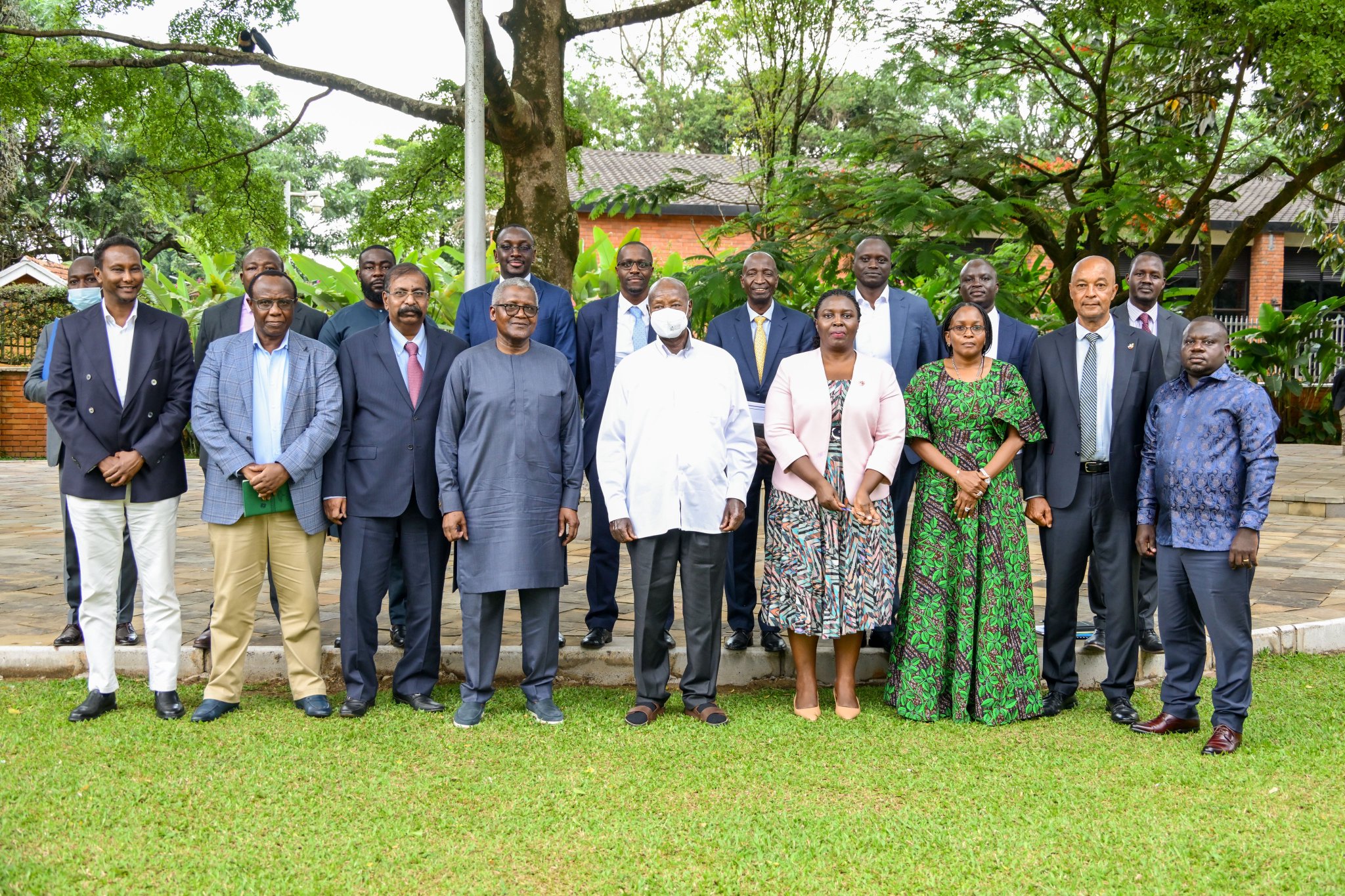


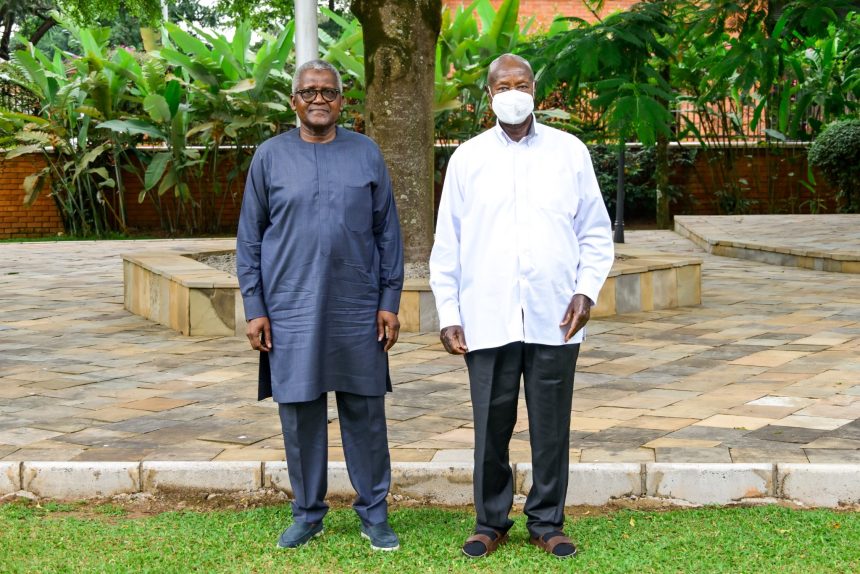
Ugandan President Yoweri Museveni has endorsed a proposed East African regional oil refinery following high-level talks with Nigerian billionaire Aliko Dangote, describing the initiative as a major step toward African industrialization, energy security, and regional economic integration.
Speaking after meeting Dangote at State House Nakasero, Museveni reiterated Uganda’s long-standing position against exporting raw materials without local value addition.
“Uganda delayed oil production because we insisted on first having a refinery,” Museveni said. “Without refining our oil, it would not make economic or strategic sense to simply export crude oil while others benefit from the finished products.”
The Ugandan leader welcomed plans for a larger regional refinery serving East Africa, arguing that fragmented markets have weakened Africa’s industrial growth for decades.
“We cannot continue operating as fragmented and weak markets. If East Africa works together, such projects become more viable and beneficial to our people,” he added.
Dangote’s proposal comes as East African nations, including Uganda, Kenya, Tanzania, South Sudan, and the Democratic Republic of Congo, discuss the possibility of building a joint refinery at Tanzania’s Tanga port to reduce dependence on imported fuel products.
According to reports, Dangote said he is prepared to replicate the model of his massive Nigerian refinery in East Africa if governments in the region support the project.
He reportedly estimated the cost of the proposed refinery at between 15 billion and 17 billion dollars and said construction could take between four and five years once agreements are finalized.
The proposed facility could have a refining capacity similar to the Dangote Petroleum Refinery in Lagos, which currently processes 650,000 barrels of crude oil per day.
The refinery is widely recognized as the world’s largest single-train refinery and Africa’s biggest oil refining facility.
Dangote’s refinery, valued at nearly 20 billion dollars, officially began operations in 2024 and recently reached full refining capacity.
The facility was designed to meet Nigeria’s domestic fuel demand while exporting refined petroleum products across Africa and international markets.
Dangote has also announced plans to expand the Lagos refinery from 650,000 barrels per day to 1.4 million barrels per day, a move that would make it the largest refinery complex in the world by total capacity.
For Uganda, the regional refinery discussions complement its own ongoing plans to develop the Hoima oil refinery in the country’s Albertine region.
The Hoima project is expected to refine 60,000 barrels per day and support Uganda’s broader strategy of industrialization and energy self-sufficiency.
Uganda discovered commercially viable oil reserves nearly two decades ago, with recoverable reserves estimated at around 1.4 billion barrels.
However, the government delayed full-scale oil production partly due to its insistence on establishing domestic refining capacity before exporting crude oil.
Analysts say a regional refinery could significantly reduce East Africa’s reliance on imported refined fuels from the Middle East and help shield the region from global fuel supply shocks and price volatility.