

More than two hundred militia groups operate in the Democratic Republic of Congo especially in the jungles of East far away from the capital Kinshasa.
The Militia Groups have the past three decades played a significant influence on the Security dynamics of this mineral rich region.
Recently the Kinshasa regime established the Wazalendo paramilitary group to support the nation’s Army fight against the AFC/M23 rebels that in the past three years have seized both North and South Kivu provinces controlling a significant amount of natural resources.
The arrival of Wazalendo adds to a long list of militia groups whose interests range from ethnic determination, resources plunder and religious or cultural among others.
Such a situation has propped up concerns and fears ot fragmented governance in the security sector of the Democratic Republic of Congo.
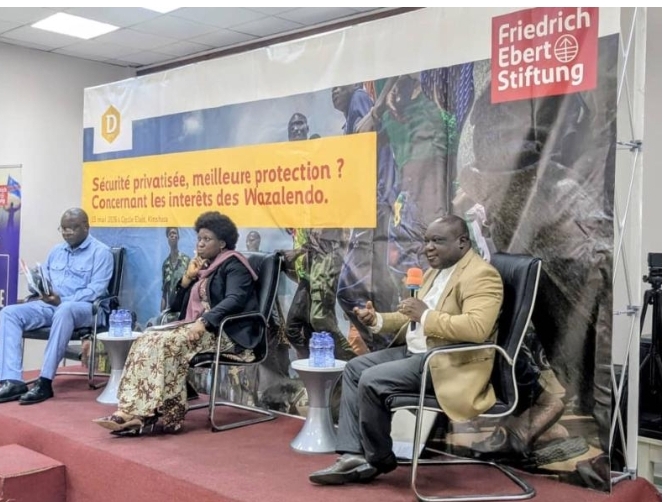
The Dynamique des politologues de la RDC (Dypol), with the financial support of the Friedrich Eber Foundation (FES), organised a political Café on Friday in the capital Kinshasa to discuss a management and organisation of paramilitary and local militia groups in the country.
The law establishing the Armed Reserve of the Defense (RAD) was adopted and promulgated.
During the deliberations the panelists raised major concerns on the operational integration of the Wazalendo militia into formal security and defence apparatuses.
“Although recognized as strategic auxiliaries of the FARDC, the Wazalendos operate in a legal gray area that makes it impossible to clearly define their status and role. This hybrid status, halfway between citizen engagement and the privatization of force, raises questions about the control and coordination of their actions with the regular armed forces,” an expert said.
“The issue of Wazalendo raises concerns about the post-conflict future of these armed groups, which were once slated for demobilization through the P-DDRSC. The absence of a robust formal framework exposes the Wazalendos to a triple insecurity from a legal, economic, and social point of view.”
The panelists also raised concern that the entanglement between ethnic and local agendas pursued by armed groups and national and regional issues pursued by the government contributes to the complexity of the conflict.
“Between the defense of the land and the territory, the complex prism of the concomitant mobilization of identities (national and local) is constructed in the service of the defense of the sovereignty of the homeland and the authority of the State and, sometimes, in the service of one’s own interests.”
In order to transform this auxiliary force into a lever of lasting stability and move from a reactive mobilization to a structured framework capable of reconciling military effectiveness and respect for the rule of law, several recommendations have been formulated.
This political discussion group recommends, in particular, that the Presidency, the Prime Minister’s Office, and Parliament establish a legal and statutory framework.
The aim is to expedite the implementation of the law on the armed defense reserve (RAD) through a decree or ministerial order.
The objective is to eliminate legal ambiguity by defining a strict transitional status that clarifies the rights, duties, and hierarchical subordination of combatants; and to ensure transparency and financial stability through the creation of a stabilization and security transition fund.