





As climate shocks intensify across East Africa, finance leaders are pushing for a decisive shift from policy design to bankable action—mobilizing large-scale public and private capital to safeguard economies and communities.
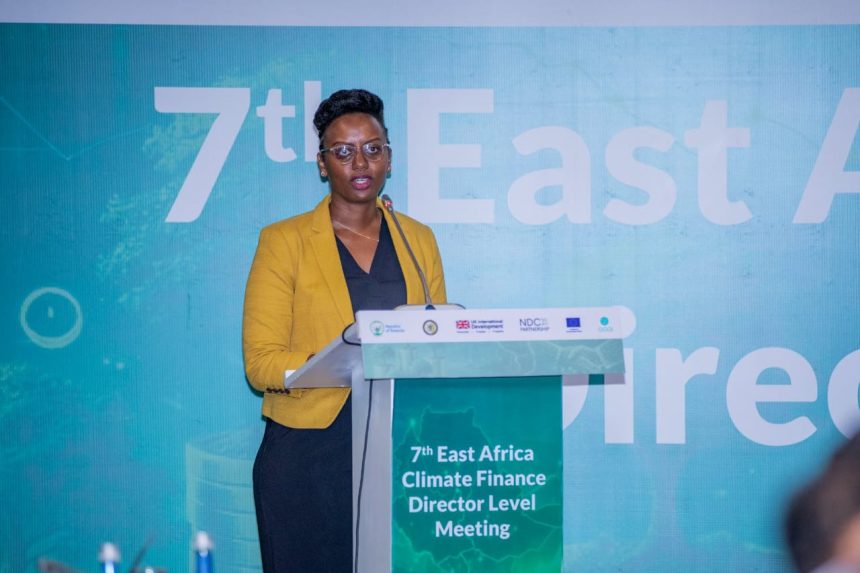
The call was underscored at the 7th East Africa Climate Finance Directors Level Meeting in Kigali, where the Global Green Growth Institute reiterated its vision of climate resilience driven by inclusive, environmentally sustainable growth. With droughts, floods, and storms already eroding food security, household incomes, and macroeconomic stability, participants agreed the urgency has never been greater.
Opening the meeting, Hon. Mutesi Rusagara, Minister of State for Resource Mobilization and Public Investment at RwandaFinance, framed climate change as an immediate economic challenge rather than a distant risk. “Public finance alone will not be sufficient,” she said. “We must mobilize a broader mix of public, private, and market-based finance—and we must do so in a way that is credible, investable, and aligned with national priorities.”
Held under the theme “From Frameworks to Action: Scaling up climate finance to advance NDC 3.0 ambitions,” the meeting brought together senior officials from Burundi, the Democratic Republic of Congo, Kenya, Rwanda, Somalia, South Sudan, Tanzania, and Uganda, alongside peer-learning countries such as Zambia and development partners. Discussions zeroed in on a persistent bottleneck: while pilots are plentiful, moving to programmatic pipelines that attract commercial banks and institutional investors remains difficult amid tightening concessional finance and constrained fiscal space.
A strong consensus emerged that finance ministries must now lead—embedding climate risk into budgets, taxation, and public investment decisions to drive resilience at scale.
Regional coordination also featured prominently. Representing the East African Community, Senior Budget Officer Beatrice Girono reaffirmed the bloc’s commitment to harmonized, well-resourced climate action anchored in updated regional instruments, from a forthcoming climate policy to strategies supporting Nationally Determined Contributions. “Regional alignment is essential to unlock finance at scale and ensure national efforts add up to shared resilience,” she said.
As the meeting concluded, participants agreed the path forward must prioritize robust project preparation, clear risk allocation, and policy certainty to crowd in private capital. East Africa, they said, has the frameworks—now it must deliver the finance to turn ambition into impact.
By Andrew Shyaka