






DAR ES SALAAM, 29 October 2025 – Tanzanian authorities imposed an evening curfew in the country’s commercial capital, Dar es Salaam, as violent protests erupted during a tense general election marred by accusations of repression, opposition boycotts, and muted responses from regional bodies.
Police chief Camillus Wambura announced on state broadcaster TBC that the curfew would begin at 6:00 p.m. local time (1500 GMT), following widespread unrest earlier in the day.
“Following the unrest which started this morning, the police alert the public in Dar es Salaam that everyone should be at home from six in the evening,” Wambura said, adding that police and military patrols would be deployed across the city.
Protests, clashes, and economic disruption
The French news agency AFP reported that hundreds of protesters clashed with police in several parts of Dar es Salaam, setting a police station on fire along Nelson Mandela Road, one of the city’s main arteries linking the port to the city center. Witnesses said police fired tear gas but were pushed back by demonstrators chanting “We want our country back.”
A heavy security presence, including tanks and armored vehicles, was deployed at major intersections to contain the unrest.
The chaos also spilled into Tanzania’s transport corridors, disrupting regional trade.
Rwandan transporters reported being caught up in the turmoil, with dozens of trucks grounded along key highways toward Rwanda. Others have opted to halt operations temporarily at the port of Dar es Salaam, fearing looting and violence.
Several logistics companies said deliveries of fuel and goods destined for Rwanda, Burundi, and eastern DRC had been suspended as authorities tightened security along export routes.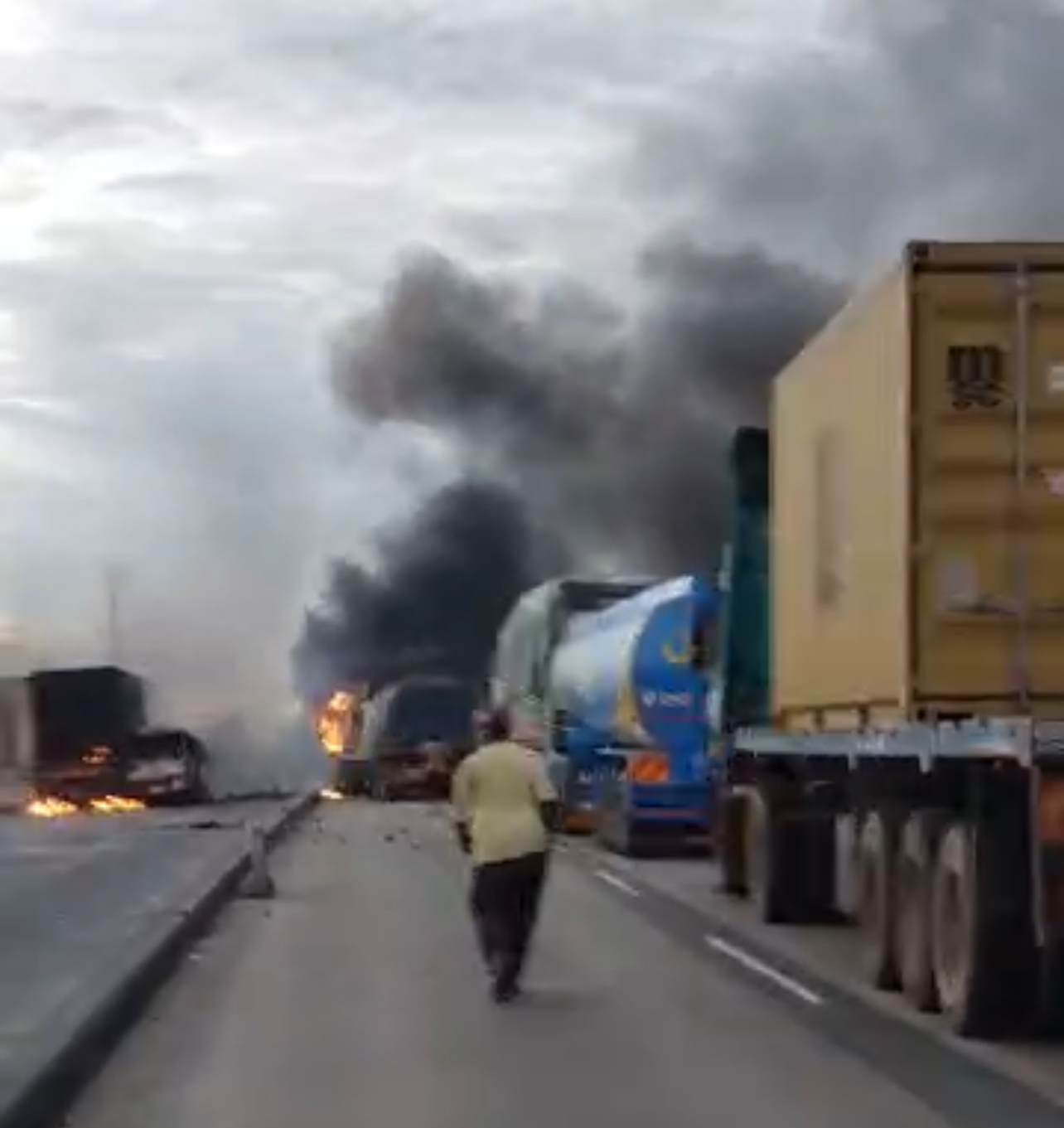
Opposition calls the vote a ‘coronation’
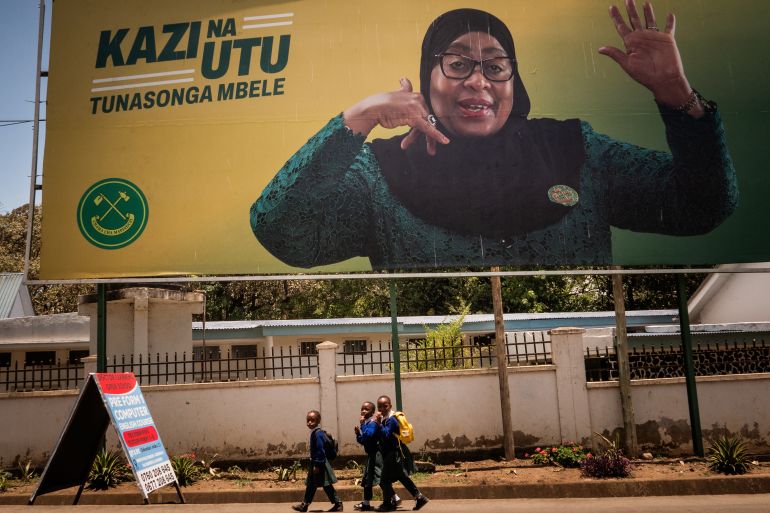
The main opposition party, CHADEMA, denounced the vote as a “coronation rather than a genuine election,” accusing President Samia Suluhu Hassan’s government of orchestrating a process devoid of real competition.
“This is not an election—it’s a coronation,” said Deogratias Munishi, CHADEMA’s secretary for foreign affairs, in an interview with Kenya’s Citizen Television. “There is no genuine contest, no fairness, and no freedom.”
The government rejected the accusations, insisting that the election was being conducted in a “free, fair, and transparent environment.” Officials also denied reports of human rights abuses and abductions of opposition leaders during the campaign.
President Suluhu Hassan, who has campaigned on her government’s record of infrastructure development and expanded electricity production, has promised continued economic progress. Preliminary results are expected within three days.
Rights groups warn of deepening repression
In the run-up to the election, the Southern African Coalition of Civil Society Organisations documented widespread human rights abuses, including enforced disappearances, police brutality, unlawful detentions, and restrictions on media and online freedoms.
The group urged “urgent international attention to prevent further deterioration of political and civic space and gross human rights violations ahead of the October elections.”
Regional and international silence
Despite mounting warnings, regional governments and institutions have been slow to react.
South Africa’s ruling African National Congress (ANC), which plays a key role in foreign policy, extended “fraternal good wishes” to Tanzania’s ruling Chama Cha Mapinduzi (CCM), praising its “enduring legacy as a liberation movement.”
“The ANC stands in solidarity with the CCM as it renews its mandate to serve the people and strengthen the bonds of friendship between South Africa and Tanzania,” the statement read.
South Africa is due to assume the Southern African Development Community (SADC) chairmanship from Madagascar, whose own 2024 elections were marred by violence and arrests after President Andry Rajoelina was deposed.
Malawi’s President Peter Mutharika, who chairs the SADC Organ on Politics, Defence and Security Cooperation, praised Tanzania’s “reputation as a peaceful nation that upholds democratic principles,” calling on political leaders “to respect the will of the people and act responsibly through legal means.”
Observers paint calm picture despite unrest
The African Union Election Observation Mission described voting as “calm and orderly” in a morning post on X, calling it an “important democratic exercise.”
However, reports from AFP and independent journalists painted a different picture—of deserted polling stations, sporadic violence, and intimidation. The European Union, which also deployed an observer team, had not issued any public statement as of Wednesday evening.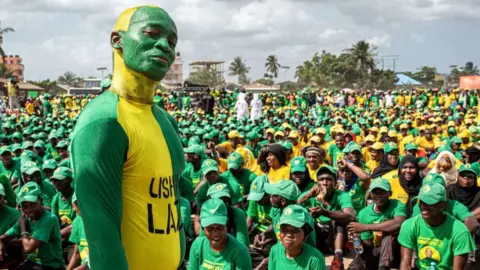
‘A democratic backslide under AU and SADC watch’
Human rights observers say Tanzania’s crisis is being allowed to fester under the complacent gaze of regional institutions.
“Tanzania’s democratic backslide isn’t taking place in a vacuum,” said Kaajal Ramjathan-Keogh, Africa Director of the International Commission of Jurists. “It is unfolding under the watch of regional institutions—particularly the AU and SADC—that have failed to raise concerns which might have placed these elections back on track.”
She noted that Tanzania’s law prohibiting challenges to election results remains unchanged despite an order from the African Court on Human and Peoples’ Rights to amend it — evidence, she said, of “an entrenched disregard for judicial and democratic norms.”
Onesmo Olengurumwa, coordinator of the Tanzania Human Rights Defenders Coalition, said regional bodies’ silence reflected their own internal weaknesses.
“These institutions are not independent,” he said. “There are so many concerns from the public and opposition parties, but you don’t see them addressing those issues.”
As night fell under curfew, Dar es Salaam’s bustling streets emptied, guarded by soldiers and patrolled by police vehicles. For regional traders, truckers, and ordinary Tanzanians alike, the city’s silence now echoes far beyond its borders—signaling not calm, but uncertainty.