






There are calamities that explode and shock the conscience of the world. And then others develop slowly, systematically and almost politely—so much that the world learns to look away without even the inconvenience of guilt. The South and North Kivu provinces in the Democratic Republic of the Congo belong resolutely to the latter category.
For over three decades, this region has been a permanent exhibition of human suffering. In a crisis—that the so-called international community visits occasionally, issues a cautiously worded statement about—and then quickly forgets over cocktails in New York, Geneva or Brussels.
What we have witnessed isn’t a lack of information or even a failure of diplomacy. It is something far more deliberate and far more disturbing. It is clear indifference dressed up as impartiality. It is partiality camouflaged as balance or weaponization of ambiguity to avoid the embarrassment of moral clarity.
The script is painfully predictable. Death of civilians. Burning villages. Displacement numbers rise. And, regrettably—somewhere, in a well-lit conference room, a statement is on computer screens: “All parties must exercise restraint.” No one is named or blamed. And, most importantly—no one is held accountable. The elusive statement is celebrated for its “measured tone,” which is diplomatic language for saying absolutely nothing.
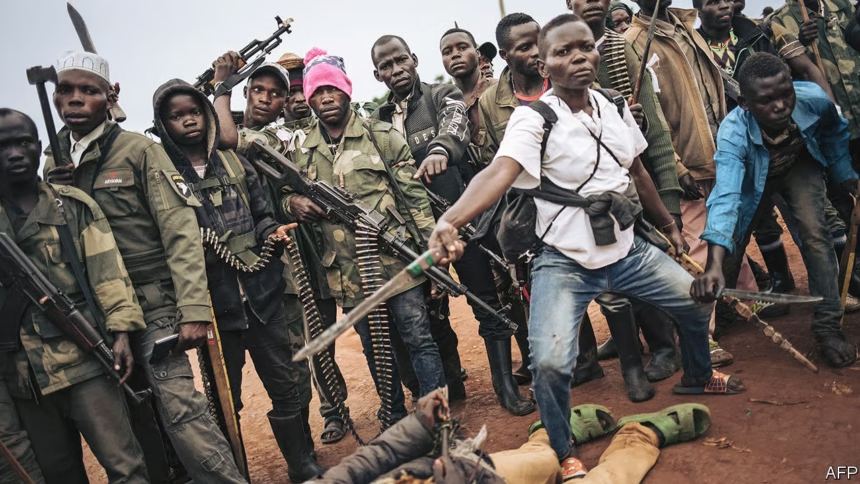
In the meantime, on the ground, reality is more of a gracious manifestation of suffering. The government of Félix Tshisekedi has, recently, chosen escalation over de-escalation. The drone strikes targeting the leadership of AFC/M23 symbolize a dangerous and extremely reckless shift in the conduct of the ongoing conflict. These are not theoretical military exercises carried out in empty battlefields. They are operations conducted in and around populated areas—places where civilians live, work, and, against all odds, to survive.
In February 2026, one of the targeted drone strikes killed Lt. Col. Willy Ngoma, the military spokesperson of AFC/M23—just days after a ceasefire agreement under the Luanda process. But the escalation did not stop there. On March 11, 2026, another drone attack targeted senior AFC/M23 leadership in the densely populated Himbi neighborhood of Goma City.
The result? Not the intended military objective, but the familiar collateral tragedy: They killed a French UNICEF aid worker and two Congolese civilians. Several other civilians were wounded, including some expatriates. Reaction? The world responded with the habitual ritual of cautiously diluted concern. There was no outrage or urgency. Just the spineless murmur of diplomatic discomfort.
We are told that “parties should avoid using drones in populated areas.” Parties? Which parties? These semantic aerobics would be inspiring if they were not so ridiculous. When responsibility is softened into abstraction—certainly, accountability evaporates entirely. Everyone becomes culpable—which conveniently means no one is.
Let us be comfortable with the fiction that these are isolated incidents. From Rubaya to Bikobokobo, from Masisi to Mushaki, and across Minembwe, drone and mortar strikes continue to rain down on areas where civilians—particularly Banyamulenge and other targeted communities—are trying to rebuild delicate lives. These are not accidents but part of a pattern. A pattern that the world has chosen to refer to as “complex,” because complexity is the last safe haven of those unenthusiastic to confront uncomfortable realities.
For the Banyamulenge and others who had begun to experience a semblance of stability under the protection of AFC/M23 and TWIRWANEHO, the situation is now one of profound confusion and betrayal. Their supposed protector speaks the language of peace at the negotiating table, while death returns to their homes from the sky. Peace, it appears, has become a routine—one in which words are cheap, and lives are disposable.
*Double Standards as Doctrine and Ambiguity as Policy*
The most astonishing aspect of this entire tragedy isn’t the violence itself. It is the reaction—or, reasonably, the absence of one. We have heard of ceasefire after ceasefire being signed and broken with the casual disregard of a New Year’s resolution abandoned by mid-January. The international reaction? A replication of the same drowsy catchphrases, recycled with minor grammatical modifications. There is no naming of perpetrators. There is no demand for accountability—and are no consequences. In a synchronized mode Kinshasa acts, Gitega collaborates and the FDLR operates. The world’s response is just simple, look for where to place a punctuation.
The FDLR is still there, as an armed group with a well-documented genocidal pedigree—continues to find space, tolerance, and a quiet collaboration within this conflict. Nonetheless, as we have observed—mentioning that too loudly would disturb the delicate balance of diplomatic euphemisms. And we can’t afford that. Taken together, clarity is dangerous; it might require action.
Even more awkward is the blatant double standard that has become the defining feature of international engagement. When AFC/M23 or Twirwaneho act in self-defense—targeting military infrastructure such as drone command centers like Kisangani airport, often with deliberate efforts to minimize civilian harm—the condemnation is immediate, loud, and morally indignant. Sanctions are threatened. Statements are issued invoking justice.
But when FARDC and FDLR and mercenaries’ operations result in several civilian deaths, when drones attack populated neighborhoods, when entire communities are terrorized, the response is mostly nuanced to the point of invisibility. That is not neutrality but complicity.
Think through the case of Uvira in December 2025. When AFC/M23 entered the lakeside town, international media fixated on the “capture” of Uvira, as though the primary catastrophe was a change in territorial control rather than the systematic persecution that precipitated it. Banyamulenge civilians had been denied access to markets and basic services. They were targeted, hunted and brutalized. Then again, that context was very inconvenient because it complicated the narrative.
When AFC/M23 withdrew in January 2026, the consequences were devastating: close to 1,000 Banyamulenge were on their way fleeing to Kamanyola. Homes, schools, and churches were destroyed; civilians identified as Tutsi were abducted and slaughtered, and of course thousands were displaced.
Yet again, the international reaction remained trapped in its much-loved mode: ambivalence. Words were selected carefully—not to reflect reality, but to avoid offending Kinshasa, Gitega and FDLR.
What we are witnessing is a failure of policy and also a letdown of moral imagination. It’s a refusal to see certain lives as worthy of dignity, urgency and protection. One can’t help but wonder: would the reaction be the same if the victims looked different? Lived elsewhere? Or fit more comfortably into the global hierarchy of empathy?
*When Survival Becomes Resistance*
The bitter truth is that for decades, many Tutsi or Hema communities in eastern DR Congo, self-defense has ceased to be a choice. When the state fails to protect you, and the international community refuses to act— or when violence is met with silence- people will certainly defend themselves. Not because they prefer war, but because the alternative is extermination.
But then again, let us go further—because the language of “necessity” often risks sounding like reluctant justification, when in fact it is a brutal indictment of systemic failure. What does it mean for a citizen to be told that their only reasonable form of existence is submissive victimhood? What kind of the so-called international order requires that communities facing annihilation must first seek permission— legal, moral or diplomatic—before defending their lives?
This is the most painful paradox: those who kill with impunity are allowed the protection of sovereignty, while those who fight back against annihilation are accused of destabilizing it. As soon as a state either cannot or will not protect segments of its population—when it accepts, tolerates, acts as a team with, or is infiltrated by forces that vigorously target those populations—it loses the moral authority to demand monopoly over violence.
Logically, sovereignty isn’t a supernatural entitlement but a contract. When that contract is broken—repeatedly, systematically, and violently—it cannot be invoked selectively as a shield against scrutiny while concurrently functioning as a weapon against the defenseless.
Let us forget about the comforting abstractions. If a community of people is hunted in its villages, denied food, water, and access to basic services, and marked for death based on identity—what exactly is the “lawful” or “tolerable” response expected of them? To file a complaint and wait for a fact-finding mission? To hope that a toughly worded statement in the form of a press release will arrive before the next bloodbath?
The history of Rwanda and elsewhere has already answered this question. The defeat of genocidaires has answered it pitilessly. People who do not look after themselves when marked for annihilation do not survive long enough to be remembered as victims. They are simply wiped out—and then debated in academic conferences years later.
It is fundamental to pose some questions that polite diplomacy dodges—and answer them without reluctance. Should these people give up their dignity and lives in the name of somebody else’s definition of sovereignty? The answer is NO, since sovereignty that demands submission to death isn’t sovereignty—it is tyranny outfitted in legal language.
Should a people accept slaughter and even extermination as the price of international indifference? Categorically not. And the reason is simple and clear. Indifference doesn’t absolve responsibility but compounds it. A quiet bystander to injustice isn’t neutral but an accessory. Should Banyamulenge in South Kivu or Tutsi communities in North Kivu be expected to trust state institutions that have consistently failed them, distorted their suffering, and, many times, legitimized those who persecute them? Trust isn’t dictated; it is earned. And in eastern Congo, it has been squandered over and over again.
Why should the language of “territorial integrity” be allowed to override the fundamental right to life? Territorial lines or borders on a map do not bleed, but people do. On the other hand, when those lines are just preserved at the expense of human lives, they become instruments of violence rather than markers of order.
Sovereignty, therefore, can’t be a shield behind which mass violence is carried out with impunity. Territorial integrity can’t be invoked as a sacred principle whereas citizens are treated as disposable. If these principles are to have any meaning at all, they must begin with the protection of human life—not its negotiation. Or else, we are left with an outrageous inversion of justice: a world in which the right to exist must be justified—and the power to kill is simply assumed.
If the world is serious or, let’s say, thoughtful about peace—and that is a very large “if”—then it must commence by accepting reality. Not the cleaned version presented in official briefings and meetings, but the lived truth of those on the ground. The systematic targeting of Tutsi and Banyamulenge populations in the North and South Kivu must be acknowledged for what it is. The role of extremely violent groups like the FDLR or the so-called “wazalendo” and mercenaries must be challenged honestly. And the unacceptable actions of state actors in Kinshasa and beyond need to be subjected to the same scrutiny and accountability that is so enthusiastically applied to non-state actors.
The Doha peace process, like the Luanda one before it—offers a potential path forward. But peace agreements are not magical invocations. They don’t work if they are not respected to the letter. A ceasefire that is dishonoured without consequence isn’t a ceasefire—it is just a pause between attacks.
The international community must choose what it wants to be: a bystander or a participant in justice. Because at the moment, it is shining only at performance. It issues statements, hosts conferences, and expresses concerns. And in the meantime, the cycle of violence remains unremitting. However, performance, no matter how elegant, can’t substitute for principle.
History will remember who spoke unmistakably and who hid behind vagueness. It will recall who acted—and who rationalized inaction. And it will ask, with unforgiving precision, how a world so knowledgeable managed to remain so passive. One day, when this tragedy is fully written, there will be many questions. Not just about those who committed the violence—but about those who empowered it through silence, ambiguity, and failure to act.
The planners of suffering in the DR Congo and beyond are many—but so too are the bystanders. And history has never been kind to bystanders who deliberately confuse indifference for prudence. When time comes, there will be no safe haven in technicalities. Expect no comfort in bureaucratic language. No absolution in cautiously balanced statements. Because when lives were being ruined, neutrality was not a logical position—it was a choice— with consequences measured not in words, but in mass graves.
The people of eastern DR Congo don’t need more and more carefully balanced sentences in statements premeditated to offend no one and protect nothing. They just need clarity, accountability and action. These people need mechanisms that identify and name perpetrators, enforce consequences and protect the vulnerable—not in theory, but in practice.
There are people in the Kivus who need a reorganization of priorities in which human life isn’t subordinated to diplomatic convenience. Those people need an end to the contemptuous calculus that weighs outrage against geopolitical interests and finds quietness more profitable.
And above all, they need a world that finally decides that their lives are not negotiable—that their pain isn’t an acceptable background condition of global stability—that their existence isn’t a footnote in somebody else’s strategic briefing.
The reality is, if the world continues on its existing path—of stylish statements and hollow resolve—it will not just be failing eastern DR Congo, but will be defining itself.
*Hard Lessons*
There is a peculiar cruelty in asking people to die quietly. Not to resist or to defend themselves. Not even to shout too loudly—since that might bother the carefully maintained illusion of “stability.” Instead, they are expected to submit, to endure, to disappear slowly but surely, politely, and without causing diplomatic problems. This is the undeclared policy that has governed the fate of many communities in eastern DR Congo for decades. It’s not written in any treaty or declared in any speech. Nonetheless, it is enforced through silence, haziness—and through the quiet complicity of a world that has learned to normalize their anguish.
There is what this expectation amounts to. It is a demand for voluntary mass suicide—with spectators. When communities are systematically targeted, also denied access to basic needs and services—when they are hunted because of who they are, and when every plea for protection is met with ambiguous declarations and diplomatic hedging, what remains? There is no legal doctrine, ethical framework or philosophical principle that can persuasively argue that they should simply tolerate. To demand obedience under such circumstances is to demand extinction.
The spiteful reality is that for many communities in eastern Congo, self-protection remains a necessity forced by abandonment. When violence is met with silence and the state fails to protect because it is complicit, when the international community declines to act, inevitably people will defend themselves. Not because they favour war, but because the alternative is annihilation.
In effect, this is one of the oldest principles in political philosophy. John Locke maintained in the Second Treatise of Government (1689) that the very purpose of political society is the preservation of life, liberty, and property. When a government methodically fails in this responsibility—or worse, becomes an agent of devastation—it dissolves its own legitimacy. Locke argued that the people are then “absolved from any further obedience” and preserve the natural right to defend themselves. This isn’t rebellion, but the restoration of a fundamental right that predates the state itself.
Likewise, Thomas Hobbes, who often appealed to justify strong sovereign authority, was unequivocal on one point: the right to self-preservation is inalienable. In Leviathan (1651), Hobbes makes clear that no individual can be obliged to surrender their life, even to a sovereign. To do so would be to negate the very foundation of human existence. A social contract that demands death in exchange for order isn’t a contract—it is a death sentence.
And yet, this is precisely the logic being imposed, implicitly and explicitly, on vulnerable communities in eastern Congo. They are told, in effect: trust the state that fails you, respect the sovereignty that does not protect you, and refrain from defending yourselves—even as you are targeted. This isn’t law but moral absurdity.
Modern political theory has simply perfected this critique. In The Origins of Totalitarianism (1951), Hannah Arendt, cautioned of the dangers of reducing human beings to what she called “superfluous people”—individuals whose lives are no longer considered necessary within the political order. When people are rendered unneeded, their annihilation ceases to provoke indignation. Instead, it becomes an administrative detail, a regrettable but tolerable cost.
Is this not what we are witnessing? A grading of human value in which some lives are defended enthusiastically—while others are quietly negotiated away?
Giorgio Agamben takes this further in Homo Sacer: Sovereign Power and Bare Life (1995), describing individuals who can be slaughtered without the act being considered a crime. In such a condition, a people exist outside the protection of the law though still being subject to its force. Their lives are reduced to what he terms “bare life”—existence denied of political meaning and protection. For so many in eastern DR Congo, this isn’t theory—it is a lived reality.
When the state in Kinshasa engages in violence against its own citizens and then offers “deals” to obscure or deactivate accountability—ceasefires minus dialogues, deprived of justice—they are not resolving any conflict. They are managing perception. They are transmuting victims into inconveniences and statistics—and, into disposable elements of a bigger political equation. In such a system—victims are not simply murdered, they are erased.
Their misery is reframed as a complexity, whereas their deaths are absorbed into elusive language like “all parties.” Their identities are stripped of meaning, reduced to numbers in reports that few will read and fewer will act upon. These people become, quite literally, garbage in the dustbin of geopolitics—forgotten, and simply replaced by the next crisis.
And the world watches with concern, with statements and carefully adjusted neutrality that avoids offending villains, while offering no protection to victims. That isn’t passive observation. It is active abdication.
Frantz Fanon, in The Wretched of the Earth (1961), understood this forcefully with clarity. He maintained that when a system is built on violence and dehumanization, appeals to morality only are not enough. The oppressed are facing a structure that depends on their subjugation. In such a context, resistance isn’t just a reaction—it is an affirmation of humanity.
Fanon’s principle is time and again caricatured; however, its fundamental insight remains profoundly pertinent. When existence is threatened, the act of resisting turns into a proclamation that one’s life has importance.
This is the honest bottom line of the matter. To deny groups of people the right to protect themselves despite systematic violence is to deny their humanity. It is to insist that their lives are expendable, conditional and negotiable.
Back to the questions that polite diplomacy evades. Should these communities submit their lives and dignity in the name of someone else’s definition of sovereignty? Certainly, no. Since sovereignty that can’t safeguard life loses its moral foundation. In The Social Contract (1762), Jean-Jacques Rousseau argued that political authority is only legitimate inasmuch as it reflects the general will and serves the common good. A state that systematically disregards and targets parts of its population is no longer expressing a general will—it is a force of domination.
Must they accept annihilation as the price of international indifference? Without question, not. Indifference does not neutralize discrimination; it amplifies it. Martha Nussbaum, in Creating Capabilities: The Human Development Approach (2011), underscores that dignity requires the real opportunity to live without fear, violence, and dreadful conditions.
And what of territorial integrity—a sanctified norm so often raised in diplomatic discourse? It is something worth defending—but not at the cost of human life. National borders are political constructs. But human beings are not. When the protection of territory turns out to be more important than the protection of people, politics has lost its moral compass.
National sovereignty can’t be a safeguard behind which mass violence is carried out with impunity. Territorial integrity can’t be invoked as a holy principle even though citizens are treated as expendable. Accepting that is to embrace a ridiculous inversion of values— a world in which maps matter more than human lives. A world where authority is well-kept even as humanity is destroyed.
There is the blatant truth of all. To demand submission in the face of systematic violence is to advocate for disappearance, and not for peace. It is to ask people to take part in their own destruction. To walk willingly into the machinery of their destruction while the world witnesses from a safe distance, taking notes and issuing declarations.
Any unpretentious commitment to justice must begin with a simple acknowledgement: the right to live isn’t conditional but inherent. It does not depend on geopolitical calculations—or require diplomatic approval. When that right is in danger, the right to defend it is correspondingly inherent. Something less opposes peace. It is surrender to death—discreet, well-ordered, then watched by a world that has convinced itself that silence is virtue.


