




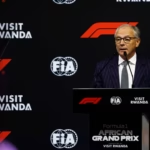


President Paul Kagame has a way of making the extraordinary feel almost matter-of-fact.
He is a battlefield strategist, a polished negotiator and, as one writer once described him, Rwanda’s top salesman. He knows how to put Rwanda in the room where big decisions are made, then make a case for why the country belongs there.
Some leaders speak about ambition. Kagame seems to work several steps ahead, turning it into a plan others can take seriously.
We have seen Rwanda host global events before. But Formula 1 feels different. It is not simply another international gathering. It is one of the world’s most watched sporting championships, with a history and a reach that stretch across continents.
And now, after the last African Grand Prix was held in South Africa in 1993, the sport has agreed to return to the continent through Rwanda. The announced 10-year agreement places the Formula 1 African Grand Prix on the calendar in the early 2030s.
For an ordinary Rwandan, that is a lot to absorb. We have heard the announcement, watched the speeches and seen the pictures. Still, the scale of it feels almost unreal. The news has arrived, but I am not sure its meaning has fully caught up with us.
I felt that most clearly late that evening, when I hosted a close group of friends. We watched President Kagame speak, followed by the Formula 1 officials. Then the evening turned into one long conversation. We debated, dissected the announcement and shared ideas about what it could mean.
There were moments of excitement, but also plenty of questions. What will it take to prepare for an event of this scale? What opportunities could open for Rwandan businesses, workers and young people? How might this change the way the world sees Rwanda, and how Africans see themselves in a sport that has been absent from the continent for more than three decades?
The announcement gave us a glimpse of the ambition behind the project. The planned purpose-built circuit will be in Bugesera, about 40 kilometres south of Kigali, and is expected to meet FIA Grade 1 standards.
 The design is intended to follow the area’s natural contours, with hills, elevation changes and a lake forming part of the setting.
The first race is expected in the early 2030s, after the circuit is completed.
Even hearing those details makes the whole thing feel more tangible. You begin to picture the cars sweeping through the hills, the crowd gathered close to the track, and international teams and fans arriving in Rwanda.
You also begin to understand that the announcement is a starting point. A long road of planning, construction and preparation lies ahead.
That is part of what makes Kagame’s role so striking. He is a smooth negotiator, a strategist and, to many of us, a leader who seems to operate from a different altitude.
Bringing Formula 1 back to Africa was a long-standing ambition for the sport. Rwanda has now secured a 10-year agreement to host the African Grand Prix, following years of work to establish the foundations for the event.
I will share more of what my friends and I discussed, and what Rwandans may expect from this moment, in the days ahead. There is a bigger conversation to have about the opportunities, the costs, the preparations and the questions that will come with hosting a global event of this scale.
There is also a bigger African story here: what it means for the continent’s fans to see Formula 1 return, and for young Africans to imagine themselves working in, building or competing in the sport.
We have made a promise; Taarifa has decided to follow this journey closely. We will report on the preparations, the opportunities and the questions that emerge over the coming years, right through to race day.
Because this is not a moment we should only celebrate. It is a moment we should understand.


