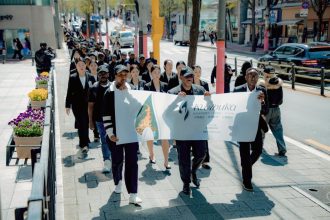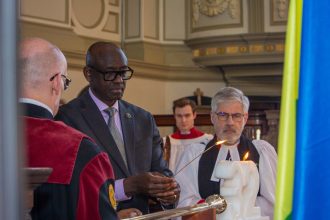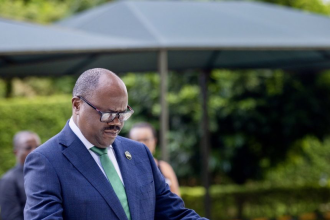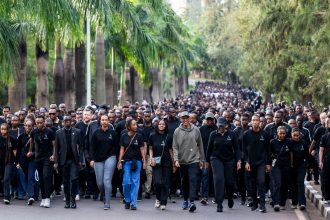




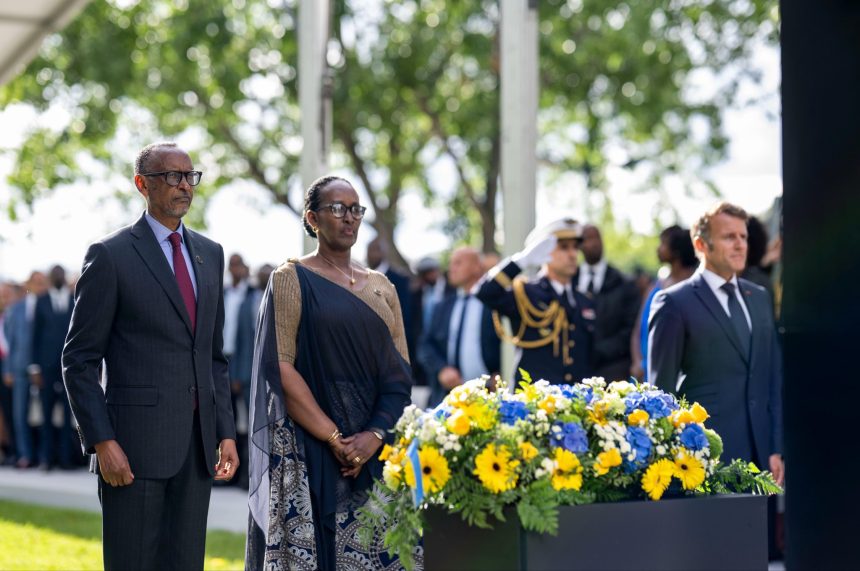
President Paul Kagame and First Lady Jeannette Kagame on Tuesday joined French President Emmanuel Macron, senior government officials, diplomats, academics, researchers and members of the Rwandan community for the inauguration of France’s first permanent national memorial dedicated to the victims of the 1994 Genocide Against the Tutsi.
The monument, known as L’Archive, stands on the Esplanade Habib-Bourguiba along the Seine River in central Paris and has been entered into France’s National Heritage Register, ensuring its preservation for future generations.
The ceremony marked another significant step in the reconciliation process between Rwanda and France, a relationship long overshadowed by France’s role before and during the genocide that claimed more than one million lives in just 100 days.
Speaking at the inauguration, President Macron described the memorial as placing the Genocide Against the Tutsi “at the heart of our capital and our history,” calling it “the culmination of a long and painstaking quest for the truth.”
Macron said the monument was not the end of a process but “a milestone on a path we have opened,” highlighting what he described as an unprecedented reconciliation between Rwanda and France.
President Kagame, in a speech that combined remembrance, historical reflection and a call for moral responsibility, said the memorial serves as a permanent guardian of truth.
“The memorial before us is powerful because it sets the truth in stone and protects it from the heartlessness of time by instructing the living,” Kagame said. “It will stand as a mark of respect for the dignity of Rwandans and our history.”
The Rwandan leader paid tribute to survivors whose testimonies continue to preserve the memory of the genocide and recalled his own experience as a refugee following anti-Tutsi violence in the early 1960s. Kagame noted that his family was forced into exile when he was four years old, a reminder that the 1994 genocide was preceded by decades of persecution and displacement.
“The events of the genocide against the Tutsi are within living memory. The work of memory necessarily begins with survivors. They are living memorials, not only by virtue of the visible scars of the body but also the indelible wounds of the spirit which they transmit to us through their testimony,” he said.
In one of the most significant moments of his address, Kagame praised Macron for confronting France’s historical responsibilities despite political opposition.
“Confronting historical responsibilities requires real courage because it generates fierce opposition by those with a case to answer,” Kagame said. “President Macron, I want to commend you on both counts, courage and humanity.”
Kagame pointed to Macron’s landmark visit to Kigali following the release of independent French and Rwandan reports that concluded France bore serious responsibilities and could have done more to stop the genocide. At the time, Macron acknowledged that France had failed to act despite being in a position to do so, a statement Kagame famously described as “something more valuable than an apology: the truth.”
The President also paid tribute to former French President Nicolas Sarkozy, whose 2010 visit to Rwanda opened the door to a new phase of dialogue by recognizing France’s serious mistakes during the genocide.
“This door was first opened by President Nicolas Sarkozy,” Kagame said. “In a historic visit to Rwanda in 2010, President Sarkozy conceded serious mistakes by France and said that it was not up to the task of stopping the genocide.”
Kagame further praised French journalists, researchers, activists and historians who spent years uncovering the truth despite resistance and denial.
“The genocide against the Tutsi was foreseeable and, in fact, foreseen. France was in a unique position to observe and to act,” he said.
While acknowledging that some survivors remain dissatisfied with aspects of the official historical record, Kagame argued that France has gone further than any other country in confronting its failures during the genocide.
“Many other countries fell short as well, but none has gone as far as France in setting the record straight and accepting its part in the tragedy,” he said.
Kagame also welcomed France’s efforts to prosecute genocide fugitives living on its territory and its decision to criminalize genocide denial, stressing that accountability remains essential to preserving the truth and honoring victims.
“We appreciate the notable efforts that have been made by France to try genocide perpetrators living here and to criminalize genocide denial. That work must continue,” he said.
At the same time, the Rwandan leader emphasized that the primary responsibility for the genocide lies with those who planned and executed it within Rwanda.
“One certitude is that the main responsibility for the genocide is located within our own society as Rwandans. Others contributed, but you cannot blame them more than we do ourselves,” Kagame said.
He said accepting this reality had enabled Rwanda to rebuild, pursue reconciliation and develop institutions capable of preventing such atrocities from ever happening again.
“Rwanda’s determination to overcome its tragic history and ensure that it is never repeated has never waned and never will,” he said.
The memorial itself carries deep symbolism. Designed by Portuguese artist Grada Kilomba, it consists of two black brass steles mounted on lava stone inspired by Rwanda’s landscape and traditional artistic motifs. The monument bears inscriptions in French, English, Kinyarwanda and Swahili and commemorates the victims while creating a permanent space for remembrance, education and reflection in the heart of Paris.
Closing his remarks, Kagame said the significance of the memorial extends beyond remembrance and reflects a shared commitment to future generations.
“The work we are doing together will give future generations the tools to build and sustain the peace and understanding which we seek,” he said. “That is the deeper significance of this moment.”
The unveiling of L’Archive stands as one of the strongest symbols yet of France’s ongoing reckoning with the Genocide Against the Tutsi and of the transformation of relations between Paris and Kigali from decades of tension to a partnership increasingly grounded in truth, accountability and mutual respect.