


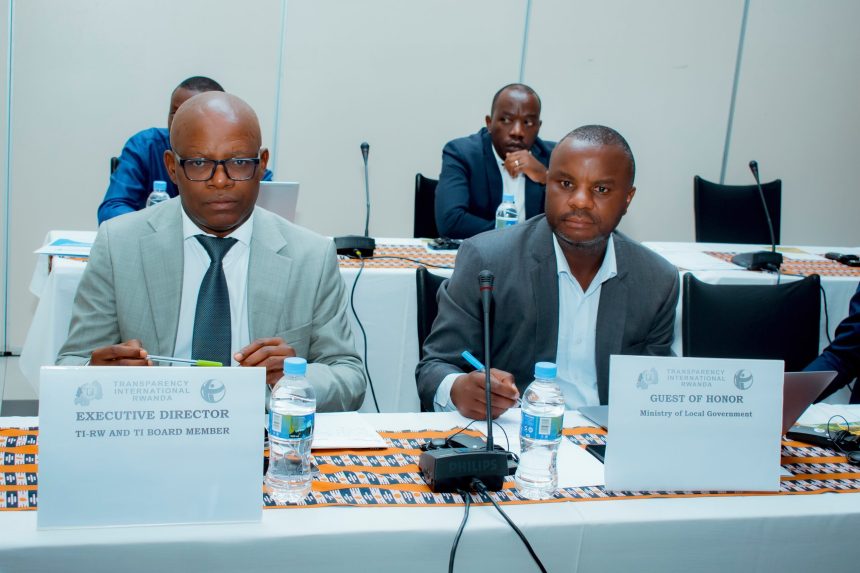
A new report by Transparency International Rwanda has revealed increasing weaknesses in Rwanda’s public financial management, particularly in procurement, asset management, and compliance with regulations.
The findings are based on reports from the Office of the Auditor General covering all 27 districts and the City of Kigali for the fiscal year ending June 30, 2024.
According to the report, weaknesses in budget execution rose by 38 percent, increasing from Rwf 1,132.027 billion in the 2022/2023 fiscal year to Rwf 1,343.853 billion in 2023/2024.
Asset management issues also worsened significantly, rising by 95 percent, while irregularities related to budget use increased by 250 percent, pointing to growing inefficiencies in the handling of public resources.
One of the most concerning trends is the sharp increase in unsupported expenditures. These rose by 355 percent to reach Rwf 13.354 billion, with 93 percent linked to budget execution. The report highlights this as a major gap in accountability and financial record-keeping.
Non-compliance with laws and regulations remains the largest contributor to financial mismanagement, accounting for 63.2 percent of all issues, equivalent to Rwf 1,313.833 billion. Weaknesses in public procurement processes account for 40 percent of the problems, making procurement a major cross-cutting challenge.
The report also points to poor asset management, including idle or poorly maintained public assets, which continues to result in inefficient use of government resources.
Delays and irregularities in procurement, compensation processes, and legal disputes are also contributing to financial losses and affecting service delivery. For instance, Rwf 10.322 billion allocated to the school feeding program was delayed, impacting beneficiaries.
Infrastructure projects in roads, water and sanitation, and health were identified as the most affected sectors. These challenges are largely linked to weak contract management, poor planning, and inadequate supervision.
Despite the concerns, the report notes some progress. For the first time since audits began at the local government level, 19 districts achieved at least a 70 percent implementation rate of audit recommendations.
Overall implementation improved to 71 percent, up from 57.16 percent in the previous year, suggesting that follow-up and enforcement of recommendations can yield results.
Speaking on the findings, TI-Rwanda Executive Director Apollinaire Mupiganyi said the issues identified are not new but continue to recur.
“There has been good progress in recent years. However, the issues we see today are not new; they are recurring problems, and their persistence calls for stronger, coordinated measures with greater accountability,” he said.
He emphasized that effective public financial management is central to governance, noting that every public resource should contribute to improving citizens’ welfare.
The report further highlights persistent weaknesses in procurement and contract management, including delays in project implementation, inadequate planning, and inefficiencies in tendering processes.
It also points to underutilization of funds and assets due to weak planning, lack of maintenance systems, and poor coordination among institutions, all of which slow development.
Additional concerns include delays in disbursing funds, particularly in social and education programs, and continued non-compliance with financial regulations.
Transparency International Rwanda has called on public institutions to strengthen transparency and accountability in procurement, improve planning and project evaluation, and enforce stronger asset management systems.
The organization also urged faster disbursement of funds for essential services and better coordination among institutions, with clearly defined roles and responsibilities in managing public finances.