






Every once in a while a law comes along that is meant to regulate something ordinary but ends up revealing something deeper about how power works.
Road traffic laws usually feel technical, almost boring. They tell us which side of the road to drive on, how fast is too fast, and when a driver has had one drink too many. They rarely stir emotions.
But when you read Rwanda’s new road traffic law carefully, you begin to see that it is not just about cars and roads. It is about authority, discretion, and how far the state can go in the name of order. There is nothing wrong with that, it’s a duty after all.
Some provisions in the new law are thoughtful and necessary. Others are vague, heavy-handed, or strangely silent where clarity should have been obvious.
The result is a law that could either make roads safer—or make the relationship between drivers and authorities unnecessarily tense.
As an old saying goes, “a good fence makes good neighbors.”
A good law does the same thing: it draws clear lines so that everyone knows where they stand.
This new law draws those lines well. At other moments, it leaves them blurred.
Let us begin with the articles that make one pause.
The Articles That Raise Eyebrows
Some provisions in the law are not problematic because of their intention. They are problematic because of how loosely they are written.
A law should be like a well-marked road: clear signs, clear lanes, no guessing.
In several parts, this law asks citizens to guess.
Let me pick some.
Article 10: Testing Drivers “Whenever Necessary”
The law allows alcohol or drug testing whenever necessary. On the surface, this sounds reasonable. No one wants intoxicated drivers behind the wheel on our streets. But the phrase “whenever necessary” is like telling someone to “drive carefully” without defining what careful means.
Necessary according to whom? Based on what evidence? Under what circumstances? The law does not say.
Imagine a young driver returning home late from work. He is stopped at a roadside checkpoint.
He has committed no traffic violation. His car is in perfect condition. Yet an officer decides a test is necessary.
Under the law as written, the driver has little ground to question the decision. There are no provisions binding the officer to exercise restraint, not to abuse the powers entrusted to him by this law.
In legal drafting, vague phrases are like loose bolts on a wheel. The car may still move, but the ride becomes unpredictable.
In many countries, such tests require reasonable suspicion or are conducted during structured checkpoints. The purpose is simple: power must be guided by rules, not moods. Many Rwandans can understand the context where my argument is coming from.
As the saying goes, “power without guardrails is like driving downhill with no brakes.”
Article 6: When the Officer Becomes the Law
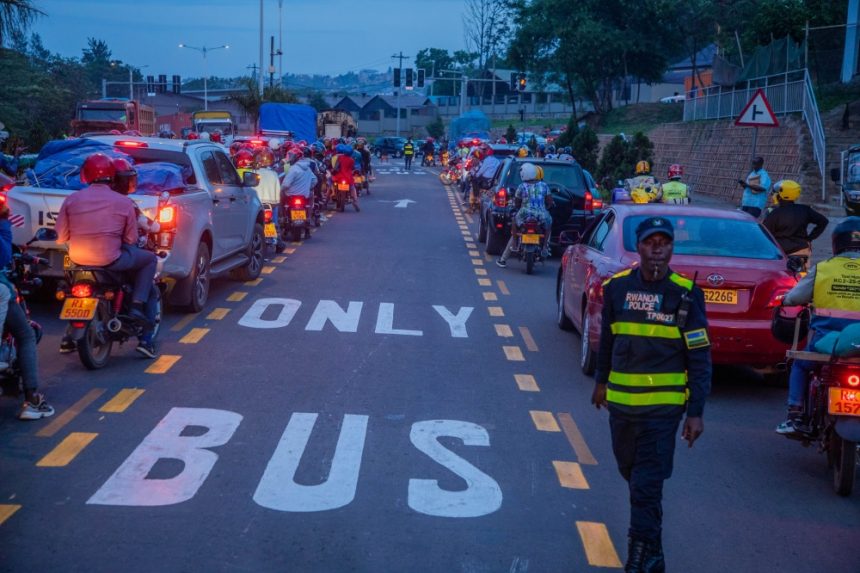
This provision states that instructions from an officer can override traffic signals. In emergencies this makes sense. Anyone who has seen a major accident knows that traffic police must take control.
But the law never explains when this authority begins or ends. This creates an unusual hierarchy where a raised hand can replace the entire traffic system.
Anyone who has driven through a busy intersection during rush hour knows the scene: one officer waves cars forward while another, fifty meters away, signals them to stop.
Drivers inch forward nervously, wondering which instruction carries the real authority. Additionally, it creates a legal hullabaloo in court. It’s incumbent upon the prosecutor to provide irrefutable evidence to the court if indeed the defendant committed the offense. Do you see where this goes? Drama!
Without clear limits, enforcement risks becoming improvisation.
Article 7: Technology Without Guardrails
This provision authorizes the use of technology for monitoring traffic.
On paper, this is progress. Cameras, automated speed detection, and digital enforcement systems are common across the world.
But the law leaves a crucial question unanswered.
What happens to the data? Where is it stored? How long is it kept? Who can access it?
In the digital age, information is power. A system installed for traffic monitoring today could easily become something much broader tomorrow.
Technology is like a machete. In careful hands it clears the path. In careless hands it cuts everything around it.
A law that opens the door to surveillance should also build the walls that contain it. The law doesn’t provide for limits. We have all seen videos and photos of suspects shared on social media by officers, completely detrimental to one’s mental state, privacy and safety. This law must explicitly provide for how such content is handled.
Article 18: Impoundment as Punishment
Another controversial provision allows vehicles to be impounded for administrative violations such as unpaid fines or delayed ownership transfers.
On paper this sounds like strict enforcement. But enforcement must always ask a simple question: is the punishment proportional to the offense?
Consider a taxi driver whose vehicle is seized because of a delayed administrative transfer.
For that driver, the car is not just a car. It is the school fees for his children, the rent for his home, the groceries for his family.
Seizing it may turn a minor administrative error into an economic crisis. It is like burning down a house to kill a rat. The intention is positive, but it does not protect the offender from excessive force beyond reasonable limits.
Article 19: Three Months Without a Vehicle
The law even allows vehicles to remain impounded for up to three months. Three months may not sound long in legal language. On paper it is simply ninety days.
But in real life, ninety days without your primary work tool can be devastating.
For a delivery driver, it means three months without income. For a transport operator, it may mean losing clients and income permanently.
Punishments must not only be legal. They must be sensible. As elders often say, “when punishing the cow, do not break the farmer’s plough.”
The Curious Silence of the Law
Sometimes the most revealing parts of a law are not what it says, but what it fails to say.
One striking omission is the absence of clear definitions for key actors.
The law repeatedly refers to “investigators” and “officers.”
But it never explains who these individuals are.
In Rwanda’s everyday reality, these roles are often the same person: a police officer who stops the vehicle, investigates the violation, and enforces the sanction.
One person becomes referee, investigator, and judge at the same time.
That may be efficient. But efficiency is not always the same as fairness.
The Mystery of the Fees
Another curious feature is the frequent mention of fees associated with enforcement.
Vehicles that are immobilized or impounded incur costs. But the law rarely explains how these fees are determined or limited.
For many drivers, retrieving a vehicle could become an unpleasant surprise. Is the fee modest?
Or does it quietly grow into something substantial?
In law, uncertainty about money is rarely a good sign.
When rules about fees are vague, citizens begin to feel like they are entering a marketplace where the price changes depending on who is asking. How did the lawmakers come to the specific fees? What’s are the metrics, benchmarks?
The Articles That Get It Right
Despite its weaknesses, the law also contains thoughtful provisions that deserve recognition.
Article 1: A Clear Purpose
The law clearly states its objective: preventing road traffic accidents. This matters.
In legal interpretation, purpose acts like a compass. When judges confront unclear provisions, they often ask what the law was trying to achieve.
By grounding the legislation in public safety, parliament establishes a legitimate and important goal.
Article 4: Driving on the Right
Some laws are strong because they are simple.
The obligation to drive on the right side of the road leaves no room for interpretation. There is no debate. No discretion.
Just a rule everyone understands.
Article 9: Alcohol Limits
Setting a measurable alcohol limit for drivers is a sensible policy. Clear numbers reduce arguments. 0.8, period!
Drivers know the boundary. Officers know the boundary. Courts know the boundary.
Clarity reduces conflict.
Article 11: Time Limits on Immobilization
Although immobilization powers are controversial, the law at least limits them to twelve hours.
Without that limit, vehicles could theoretically remain immobilized indefinitely.
Boundaries matter. That’s good.
Article 25: Monitoring Driver Behavior
Perhaps the most forward-looking provision is the introduction of a driver behavior monitoring system.
Instead of punishing drivers only once, it tracks patterns over time. A driver who repeatedly violates rules accumulates consequences.
This approach reflects a modern understanding of road safety: discipline is not built overnight.
It is built gradually.
The Bigger Picture
The real problem with the law is not that it contains flawed provisions. Most laws do. The deeper issue is imbalance.
The law provides strong enforcement powers but relatively weak procedural safeguards.
It expands authority more confidently than it defines limits.
And throughout the penalty sections, the language of imprisonment appears repeatedly, suggesting a legislative instinct toward punishment rather than correction.
For a traffic law, this emphasis is unusual. It is screaming Funga! Road safety laws are supposed to shape behavior, not fill prisons.
What This Says About Institutions
Laws also reflect the character of the institutions that produce them.
Parliament appears ambitious but perhaps insufficiently meticulous. Some provisions feel like they were drafted quickly, leaving key terms undefined. Even the translation from Kinyarwanda to English was way below basic English standards.
Additionally, the executive receives broad enforcement powers, especially through ministerial regulations and administrative discretion.
How responsibly those powers are exercised will determine whether citizens experience the law as protection or pressure.
The judiciary may eventually become the balancing force.
Courts often refine legislation by interpreting vague provisions and establishing boundaries.
Over time, case law can turn a rough law into a workable one.
A Law at a Crossroads
In the end, Rwanda’s road traffic law stands at a crossroads. Handled wisely, it could improve road discipline and reduce accidents.
Handled poorly, it could create a system where drivers feel that enforcement is unpredictable and excessively punitive.
Laws, like roads, should guide movement without crushing the people traveling on them.
A road that is too narrow causes accidents. A law that is too vague causes distrust. And in both cases, the journey becomes unnecessarily dangerous.
Those were just a few among many loopholes that I was able to point out.
Overall, we needed this law to curb unruly drivers but let it be thoroughly crafted.