






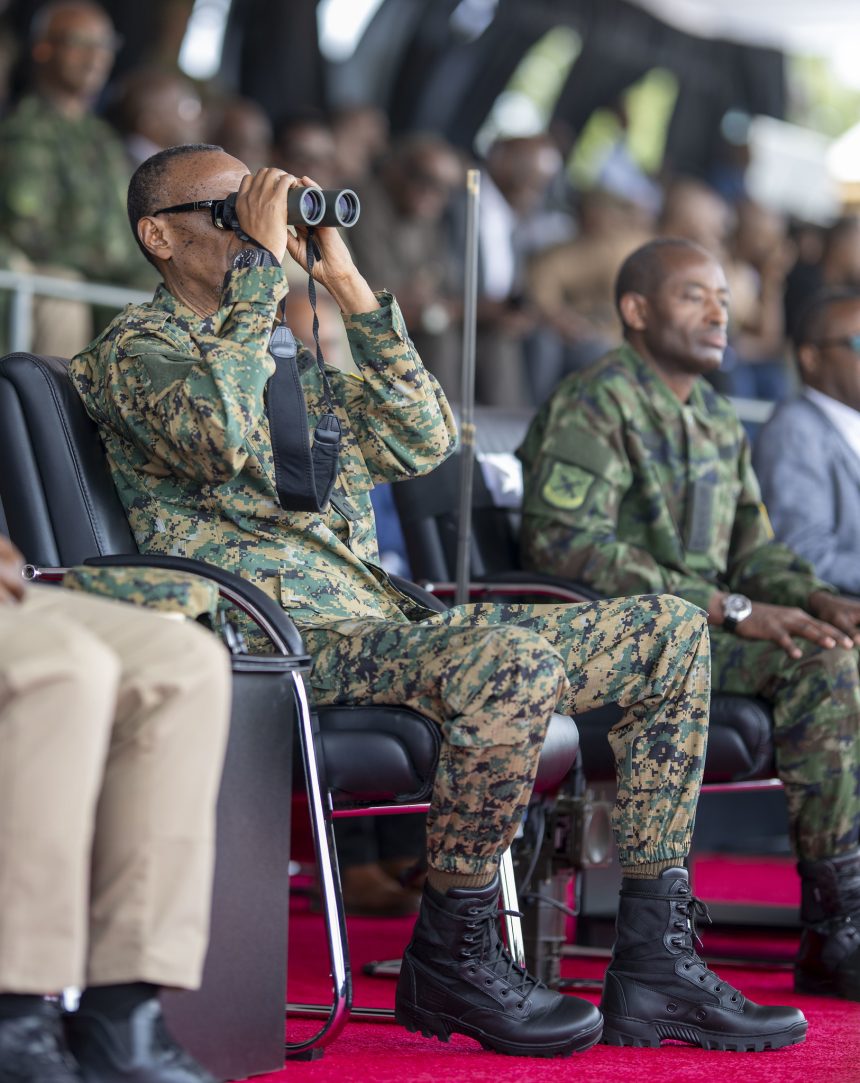
If you want to understand what is happening around Rwanda right now, you have to begin where strategists always begin: with the center of gravity.
In Rwanda’s case that center is very clear. It is President Paul Kagame and the Rwanda Defence Force, alongside the broader security architecture that moves with it by default: the Rwanda National Police, the Rwanda Investigation Bureau, the Rwanda Correctional Service, and the National Intelligence and Security Service. Everything else in the political system ultimately radiates from those pillars: leadership and security capability. Kagame has shaped the country’s political direction for decades, and these institutions together have become some of the most disciplined and operationally respected security structures in Africa. When a country’s stability, reputation, and strategic confidence are tied so closely to those elements, anyone studying Rwanda—whether ally, critic, or competitor—knows exactly where the real leverage lies.
That is why much of the pressure we are seeing today is increasingly directed at those points. Fix the target, then fix the narrative around the target. That is how pressure systems are designed.
Look at the pattern. The United States has recently imposed sanctions on individuals linked to Rwanda’s regional security environment, particularly in connection with the conflict in eastern Democratic Republic of the Congo. The language used in these measures is familiar to anyone who studies international diplomacy. It focuses on allegations, regional destabilization, and accountability. Yet behind the wording lies something more strategic: pressure directed toward the institutions and leadership perceived as the backbone of Rwanda’s influence.
Sanctions are rarely just legal tools. They are signals. They say to investors, to banks, to international agencies: pay attention, adjust your calculations, slow your engagement. It is the beginning of a squeeze.
Then other actors step in with different instruments.
Across parts of Europe the conversation shifts toward funding. Development partners begin reviewing programs. Some freeze assistance, others threaten to reconsider future commitments. The language becomes technical: “budgetary reassessment,” “strategic review,” “conditional engagement.” But the meaning is understood everywhere in policy circles. Tighten the financial environment. Increase uncertainty. Make the cost of defiance visible.
Meanwhile the narrative machinery begins to move.
Reports begin circulating. Advocacy organizations publish “special investigations.” Certain NGOs prepare dossiers that quietly find their way into international newsrooms. Journalists receive background briefings that frame Rwanda through a particular lens. Articles appear almost simultaneously across different outlets, repeating similar themes and allegations.
Once the narrative starts rolling, it becomes self-reinforcing.
Then comes another layer, one that rarely appears in public discussions. Fixers.
In Western political systems influence does not always move through official channels. Lobbyists, consultants, and political intermediaries often shape the conversation long before it reaches parliament floors or congressional committees. Officials in the Democratic Republic of the Congo understand this well. Kinshasa has invested heavily in lobbying campaigns abroad, hiring firms and intermediaries who cultivate relationships with politicians and policy networks in Washington, Brussels, and other Western capitals. The objective is straightforward: push for stronger denunciations of Rwanda, encourage sanctions, and generate political pressure that constrains Kigali’s options.
At the same time another campaign unfolds in diplomatic corridors.
Belgium, Rwanda’s former colonial ruler, has often taken a particularly active role in shaping discussions about Rwanda in European political circles. In Brussels, where European Union institutions sit at the center of policymaking, diplomatic messaging about Rwanda circulates constantly. Policy briefings are shared. Talking points are repeated. Gradually a certain tone begins to dominate the conversation.
None of these steps appears dramatic individually. But together they form a coordinated atmosphere.
And all of it loops back to the same pillars.
Because the moment you look closely at where these pressures concentrate, you see the pattern again. Kagame. The Rwanda Defence Force and the wider security ecosystem that includes the Rwanda National Police, the Rwanda Investigation Bureau, the Rwanda Correctional Service, and the National Intelligence and Security Service.
The Rwanda Defence Force and its sister institutions have developed a reputation that many security structures across the continent struggle to match. In Mozambique, when insurgent violence threatened to overwhelm the Cabo Delgado region, Rwandan forces moved quickly and helped stabilize the situation in ways that surprised many observers. In the Central African Republic, Rwandan peacekeepers have been widely recognized for protecting civilians and restoring order in volatile environments. And across United Nations and African Union missions, the professionalism of Rwandan contingents is regularly acknowledged by international commanders.
President Kagame himself recently praised the security forces for their professionalism and performance, emphasizing the discipline that defines their operations.
That reputation is exactly what makes them a strategic target.
Because if the credibility of these institutions can be questioned, if doubts can be introduced into their image as disciplined peacekeeping forces, then the entire structure of Rwanda’s international reputation begins to shift. Discredit the force. Question the leadership that commands it. Repeat the allegations until they become assumptions.
And while this is happening, another front opens quietly in the information space.
Amplification.
Voices of dissent that once existed quietly on the margins suddenly begin appearing everywhere. Television interviews. Newspaper columns. Radio broadcasts. Podcasts. Social media spaces where narratives spread quickly and emotional language travels even faster than facts.
This pattern is not new. It has unfolded in stages.
At one point the trumpet was handed to Kayumba Nyamwasa. His voice was amplified across platforms abroad. For a period he became the centerpiece of a particular narrative about Rwanda’s leadership. But eventually the momentum faded.
Then the spotlight shifted. Paul Rusesabagina, convicted in Rwanda for terrorism-related charges, suddenly became the new symbol amplified in international debates. His story traveled widely through Western media and advocacy networks. Yet over time that narrative also lost traction.
After that, attention turned to networks around Victoire Ingabire. Her supporters were given increasing space in policy forums and media discussions. But that effort too began to lose energy.
Now the baton appears to be passing again, this time toward networks associated with the son of former President Habyarimana and a loose collection of figures who circulate across exile communities and online platforms.
To anyone observing the pattern closely, it feels less like coincidence and more like choreography.
When one voice loses momentum, another appears. When one narrative fades, another replaces it.
The objective is constant pressure on the legitimacy of leadership.
And Kagame himself becomes the central focus of that pressure.
He is widely known among diplomats as a leader who does not easily bend under external demands. That reputation for stubborn independence, admired by some and resented by others, becomes another reason the pressure continues. If he will not back down politically, the strategy shifts toward weakening the institutions around him.
That brings the attention back again to the security forces: the Rwanda Defence Force together with the Rwanda National Police, the Rwanda Investigation Bureau, the Rwanda Correctional Service, and the National Intelligence and Security Service.
Target the force. Question its achievements. Frame its regional operations as destabilizing rather than stabilizing. The logic is simple: if the credibility of Rwanda’s most respected institutions can be undermined, then the broader narrative about the country begins to change.
Meanwhile contradictions emerge that many observers quietly acknowledge but rarely discuss openly.
Take the example of Rwanda’s gold sector. When sanctions or regulatory scrutiny target facilities such as the Gasabo Gold Refinery, the public language centers on accountability and transparency. Yet in private commercial channels the same international markets continue placing orders and maintaining relationships. The official posture condemns. The commercial reality continues.
It is one of those moments where geopolitics and economics expose the uneasy moral contradictions of the system.
And so the picture becomes complicated. Sanctions tighten from one direction. Funding threats appear from another.
Lobbying campaigns amplify accusations. Narrative machinery produces headlines. Dissenting voices are elevated, rotated, and replaced as needed.
All the pressure converges on the same focal points.
Kagame.
The Rwanda Defence Force and the wider security ecosystem: the Rwanda National Police, the Rwanda Investigation Bureau, the Rwanda Correctional Service, and the National Intelligence and Security Service.
And by extension the country itself.
At this point one has to pause and ask a more fundamental question.
Ask yourself, what is it that Rwanda has done or possesses that makes everyone suddenly go nuts, guns blazing?
Because frankly, it is not the alleged support of M23. No. The real issue runs deeper than that.
It is something immaterial and strategic. Rwanda has a tendency of throwing away the script and doing something different. Kagame’s signature moves. He is fluid and meticulous. Acting surgically outside the expected template. Refusing to play the quiet role assigned to small countries. Building institutions that function. Deploying forces that deliver results. Speaking in international forums with a confidence that unsettles established expectations.
That is the real disruption. It’s Rwanda’s biggest currency.
And disruption in geopolitics always carries a price.
In the end Rwanda finds itself paying a price for two things that rarely sit comfortably in the international system: defiance and a stubborn moral compass.
For some observers the entire spectacle begins to look less like principled diplomacy and more like something messier, something shaped by competing interests and strategic discomfort with a country that refuses to behave quietly.
Kigali watches the pattern unfold and asks a question that echoes beneath the noise of global debates.
Who are we, they ask, that independence should carry such a cost?
Because in the end that is the uncomfortable truth: stepping off the script is allowed in global politics, but it is never free. It is always expensive. And Rwanda is learning just how expensive it can be.
And that’s how I see it.