


Rwanda’s President, Paul Kagame, has reiterated the country’s commitment to nuclear energy as a cornerstone of its long-term development strategy, saying abundant electricity will be essential for Rwanda to achieve its ambition of becoming a high-income nation by 2050.
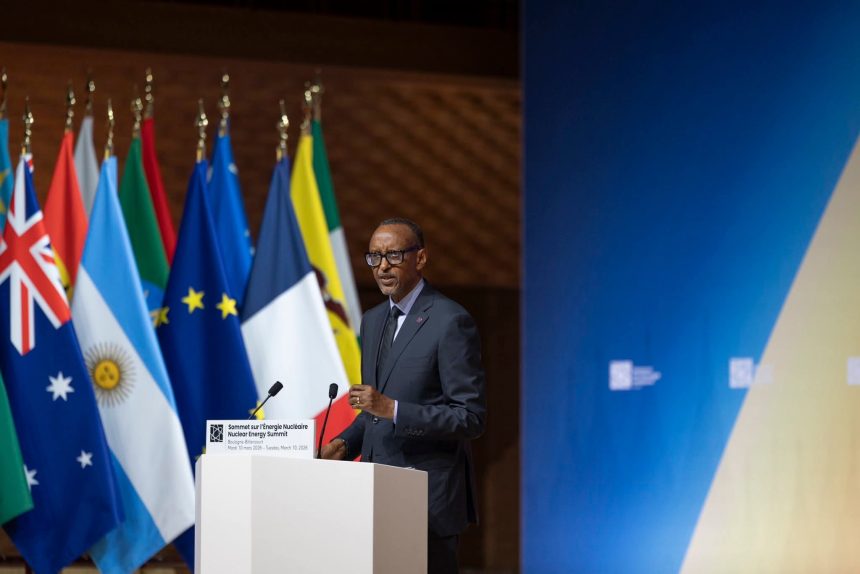
Speaking during the Nuclear Energy Summit in France, Kagame emphasized that Rwanda is ready to take the necessary steps to integrate nuclear power into its energy mix as part of a broader plan to accelerate economic growth and industrialization.
“Rwanda aims to be a high-income country by 2050. That requires abundant electricity, and that is why we have decided to make nuclear energy central to our strategy,” Kagame said.
“Achieving this requires strong institutions, sound regulation, and an educated workforce, and that is the foundation Rwanda is building. Rwanda is determined to do what it takes to power our development with nuclear energy, and we look forward to you being a part of this journey.”
Kagame is among global leaders attending the second international summit focused on the role of nuclear energy in global development. The meeting is hosted by French President Emmanuel Macron in Boulogne-Billancourt near Paris and has brought together representatives from around 60 countries.
The summit is organized by the French government in partnership with the International Atomic Energy Agency (IAEA), the global body responsible for promoting the safe and peaceful use of nuclear technology.
President Kagame is attending the meeting with a Rwandan delegation that includes officials from the Rwanda Atomic Energy Board. The delegation is participating in discussions on how nuclear energy can support sustainable development and help address growing global energy demands.
Opening the summit, Macron highlighted the strategic importance of nuclear power for both economic progress and energy security.
“We are here because we share a simple idea,” Macron said. “We need nuclear energy because it is a source of development and independence.”
However, he noted that global conversations about nuclear power are unfolding at a delicate time, with geopolitical tensions—including the ongoing situation involving Iran and instability in the Middle East—adding complexity to international energy discussions.
The first edition of the summit was held in Brussels, Belgium, in 2024. This year’s meeting is focusing on how nuclear energy can contribute to development while helping countries respond to energy shortages and climate challenges. Financing nuclear projects is also expected to be one of the key issues discussed.
The summit comes shortly after the IAEA sent an inspection mission to Rwanda as part of ongoing assessments linked to the country’s nuclear energy ambitions.
Rwanda has previously announced plans to explore the use of Small Modular Reactors (SMRs) as a future source of electricity. Officials say the technology could complement existing hydropower resources and help meet the country’s rapidly growing energy demand.
The IAEA mission is believed to have evaluated Rwanda’s readiness and identified the regulatory, technical, and institutional requirements that must be met before the country can begin developing nuclear power generation.
Rwanda’s presence at the summit underscores its broader strategy of embracing advanced technologies and diversifying energy sources to support sustainable economic growth.
For Kigali, nuclear energy is not only about electricity production—it is increasingly viewed as a long-term investment in national development, technological capacity, and energy independence.
By Andrew shyaka