



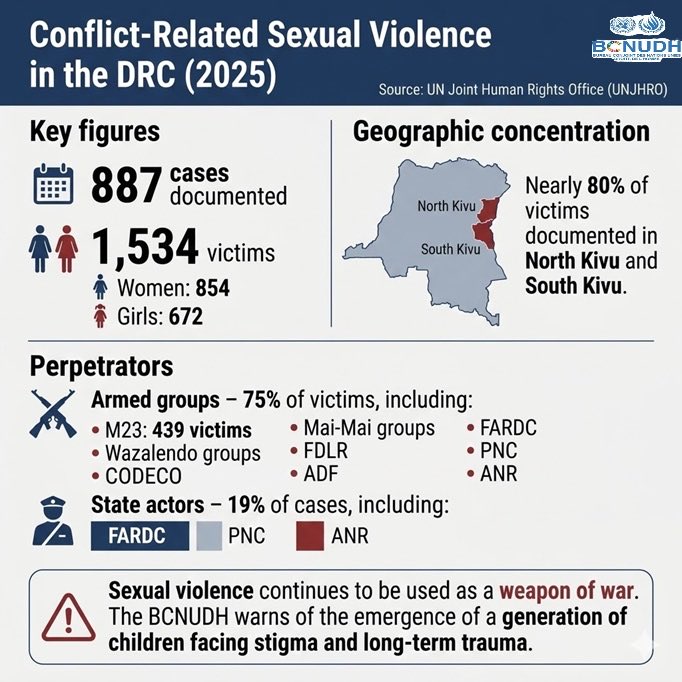
Have you all seen what MONUSCO has published? Some ugly stuff, total rubbish it called a report about sexual violence happening in eastern Congo.
See, some reports do not merely describe a conflict. They quietly decide who will stand in the dock and who will fade into the background.
The recent infographic circulated by MONUSCO and the UN Joint Human Rights Office, reads less like a neutral document and more like a carefully arranged courtroom scene where the verdict seems predetermined.
The report in question is wrapped in the language of humanitarian concern and statistical authority. Icons, maps, and neat figures created the impression of precision and moral clarity. At the center of the presentation sat a number pointing squarely at the M23.
To readers thousands of miles away, the message would appear straightforward: another armed group accused of brutalizing civilians.
But the reality in eastern Congo is far more complicated, and far more uncomfortable for those producing such reports.
For more than twenty years the United Nations mission has operated in the region. It is one of the longest-running and most expensive peacekeeping missions in the world. Billions of dollars have been spent. Convoys patrol dusty roads, helicopters circle mountains, and blue helmets remain a permanent feature of the landscape.
Yet the war never disappeared.
Armed groups multiplied. Villages emptied. Entire communities learned to survive between checkpoints and gunfire. A mission built to stabilize the region has watched instability harden into routine.
That failure forms the unspoken background to every new report.
Eastern Congo is not a simple conflict between two sides. It is a maze of militias and armed actors. Groups such as FDLR, ADF, Mai-Mai operate alongside pro-government militias often called the Wazalendo. Units of the national army, the FARDC, have also faced repeated accusations of abuse.
This is the chaotic landscape in which the M23 exists.
Supporters of the movement argue that it arose from communities who believed they were marginalized, persecuted, and left exposed to hostile militias. In that narrative, M23 fighters are not outsiders but people defending their own homeland against violence and neglect.
Yet the report strips away that context. Instead it places a precise figure beside the name of the movement, presenting it as a primary perpetrator.
This is where the problem begins.
Several armed groups appear in the report, but without detailed numbers. Their responsibility is blurred into categories. M23, however, is singled out with an exact statistic that dominates the graphic.
That is not neutral presentation. It is narrative framing.
In conflicts, numbers shape perception. A single bold figure can define how an entire war is understood by outsiders who will never set foot in the region.
When one actor is highlighted while others are grouped together, the effect is obvious: blame becomes concentrated where the spotlight falls.
Meanwhile the broader architecture of violence fades into the background.
For many people in eastern Congo, this approach feels less like investigation and more like convenient storytelling.
Militias that have terrorized communities for years appear in the margins. State forces and allied militias receive diluted attention. Yet the movement fighting on its own territory is pushed to the foreground as the main villain.
After two decades of failed stabilization, that accusation lands with particular bitterness.
Imagine living in a region where armed groups threaten your family, where entire populations have been displaced, where the international mission tasked with protecting civilians has spent years watching the violence continue.
Then imagine the same institutions producing reports that appear to accuse the very people claiming to defend their communities of attacking those communities.
It sounds less like accountability and more like misdirected blame.
Documenting crimes in a war zone is difficult. Witnesses are afraid. Villages are inaccessible. Armed groups blend together. Attribution is often uncertain.
Those realities should encourage caution and humility.
Instead, the report delivers tidy certainty packaged in an infographic.
The deeper issue is credibility. When institutions that have struggled for decades to contain violence present simplified narratives about that violence, people begin to question whose story is really being told.
And the proverb returns once again.
The hunter writes the story, but the lion knows the truth.
Eastern Congo’s tragedy cannot be reduced to a chart that highlights one actor while softening the roles of others. The conflict is the product of years of failed governance, regional rivalries, proliferating militias, and international interventions that promised stability but delivered little of it.
When statistics are arranged in ways that shield some actors while isolating others, they stop looking like impartial evidence. They start looking like a carefully constructed narrative.
And in a region already drowning in mistrust, that is the last thing a peacekeeping mission should be producing.