
When Dr. Donald Kaberuka reflects on the origins of Rwanda’s capital markets, he does not begin with the ringing bell that marked the launch of the Rwanda Stock Exchange in 2011.
He begins with discipline that set the floor.
“You don’t simply put a stock market in place,” he says. “You stabilise the macro framework first. Without confidence, there is no market.”
In 2000, when President Paul Kagame assumed office, Rwanda was still rebuilding its fiscal credibility and financial system. External and domestic debt had to be restructured. Inflation needed to be contained. Government finances stabilised. Banks and stressed financial institutions required repair. Public trust had to be rebuilt.
“There was no point creating a stock exchange in 1998,” Dr. Kaberuka recalls. “We were fixing the macro fundamentals. That had to come first.”
By 1999 and into the early 2000s, once macroeconomic stability had taken hold, the sequencing shifted. Banks were strengthened. Non-bank financial institutions expanded. Insurance companies and pension funds were nurtured. Institutional investors gradually began to take shape. The deepening of the financial sector became deliberate policy.
The capital market was never conceived as a symbolic project. It was structural.
“For a country like ours,” he explains, “the goal is to move beyond the cycle of aid and debt. The answer is mobilising domestic savings and attracting foreign direct investment.”
That philosophy eventually culminated in the launch of the Rwanda Stock Exchange (RSE) in 2011. Over time, the Exchange has grown into a functioning capital market serving both corporate and public financing needs.
Market capitalisation today stands at approximately Frw 6.6 trillion, including Frw 4.7 trillion in equities and about Frw 1.9 trillion in debt securities. Since its establishment, the Exchange has facilitated capital raising of roughly Frw 2.71 trillion for businesses and public projects. Total market turnover has exceeded Frw 25.3 trillion, with more than Frw 28 trillion circulating through the market overall.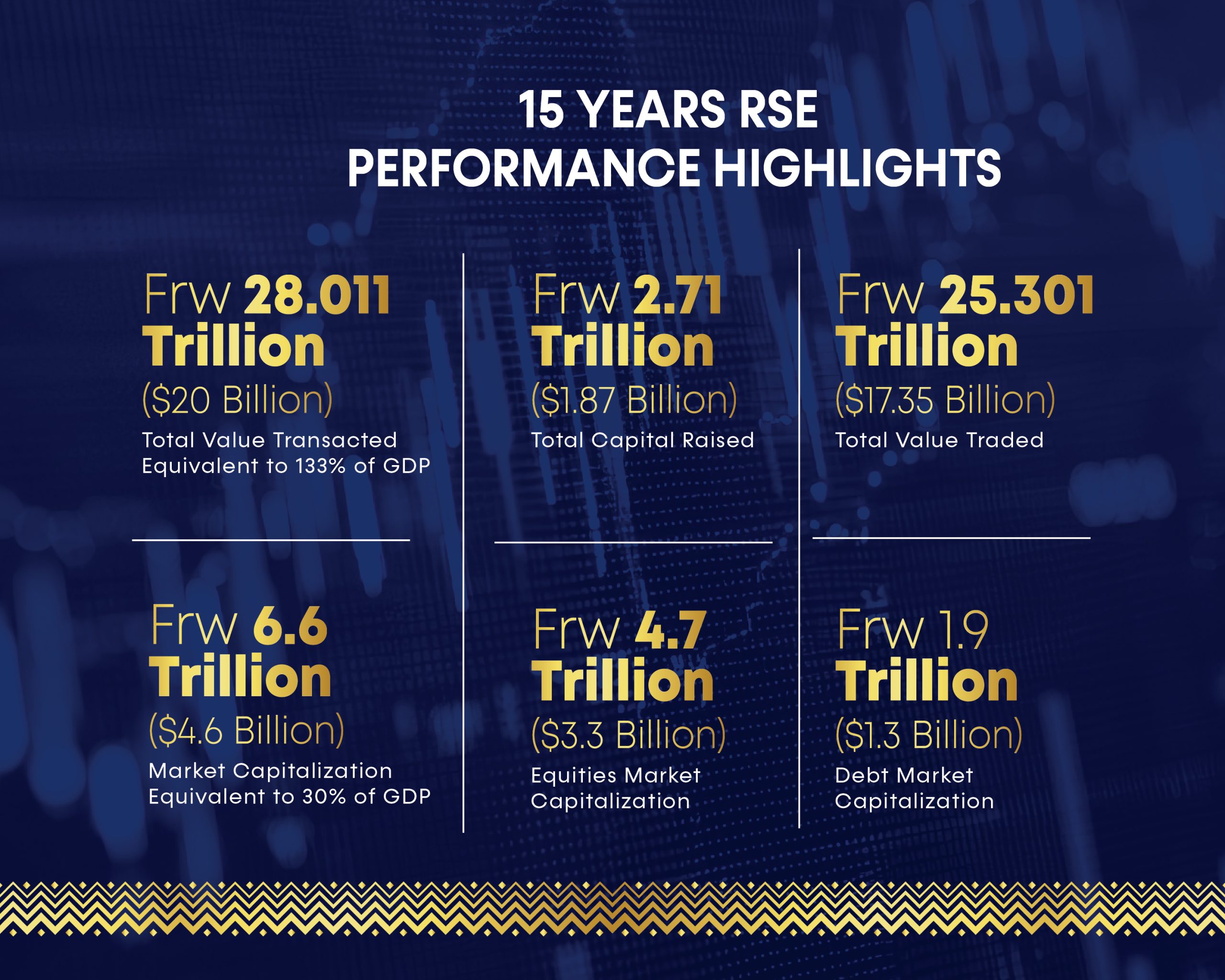
The RSE currently hosts a mix of domestic and cross-listed companies, alongside a growing government and corporate bond market. As in many emerging exchanges, debt securities—particularly government bonds—play a central role in market activity, providing long-term financing for public investment while helping establish a domestic yield curve.
More than 270,000 investors now participate in the market, the majority of them local. Institutional investors such as pension funds, insurance companies and investment funds account for a significant share of trading activity, while retail participation continues to expand through digital trading platforms and financial literacy initiatives.
Since the market opened, listed companies have distributed approximately Frw 428.6 billion in dividends.
What began primarily as a capital-raising platform has gradually evolved into a broader ecosystem for wealth creation and wealth distribution.
“You cannot rely only on banks,” Dr. Kaberuka says. “Banks have limitations. Capital markets provide long-term equity finance. They allow domestic savings to work at home.”
Across Africa, institutional savings run into trillions of dollars. Pension funds and insurance companies frequently invest abroad in search of liquidity, safety and returns. The challenge for emerging exchanges like Kigali is to create those same conditions domestically.
“If we provide liquidity, safety and reasonable returns,” he asks, “why shouldn’t Africa’s savings finance Africa’s growth?”
Liquidity, however, remains one of the defining challenges for young markets. Trading volumes on smaller exchanges are often modest, with many institutional investors adopting long-term buy-and-hold strategies. Expanding the pool of listed companies and increasing free-float shares remain central to deepening daily market activity.
Dr. Kaberuka is pragmatic about these constraints.
Rwanda faces the same structural realities confronting many African capital markets: a limited pipeline of listing-ready companies, relatively small domestic corporate balance sheets, and family-owned firms that are often cautious about the disclosure and governance requirements that accompany public listing.
Yet progress is visible. Regulatory reforms, improvements in corporate governance standards and the digitisation of trading infrastructure are gradually lowering barriers to participation.
Regional integration is another priority. Within the East African Community, efforts to harmonise capital market regulations and facilitate cross-border investment have been underway for years. While progress has been uneven—due to differences in taxation, settlement systems and regulatory frameworks—the long-term objective remains clear: a more integrated regional market capable of attracting larger pools of capital.
“We all share the same challenge,” Dr. Kaberuka notes. “The sooner we integrate, the more resources we unlock.”
In regional terms, Kigali’s exchange remains smaller than markets such as Nairobi or Johannesburg, but its growth trajectory reflects Rwanda’s broader economic model—steady institutional development built on macroeconomic stability and regulatory discipline.
The broader ambition is unmistakable. Aid may support recovery, but it is inherently temporary. Sustainable development requires investment.
Dr. Kaberuka often points to Vietnam, which moved from post-war devastation to rapid economic expansion by attracting large-scale foreign direct investment within a single generation.
President Kagame has repeatedly echoed that philosophy. Aid has its place, Dr. Kaberuka says, “but it is supposed to be temporary.”
The launch of the Rwanda Stock Exchange in 2011 was therefore more than a ceremonial milestone. It represented the culmination of a carefully sequenced economic strategy—one that began with macroeconomic stabilisation in the late 1990s, matured through financial sector reforms in the early 2000s, and evolved into a functioning capital market capable of mobilising trillions of francs.
The journey, as Dr. Kaberuka puts it, is far from complete.
“The journey is long,” he reflects, “but Rwanda is on the way.”