
The most striking signal in Rwanda’s revised 2025/2026 budget is the increase in development spending, by Rwf253.2 billion, even as the total budget envelope declined.
The government is reallocating resources toward capital formation while reducing recurrent expenditure; a strategic shift designed to sustain long-term growth.
Presented this week to Parliament by Finance Minister Yusuf Murangwa, the revised budget reflects present fiscal decisions anchored in strong recent performance.
Below are the key takeaways from the presentation, including current policy actions and recent economic outcomes.
1. Development spending is rising despite a smaller overall budget.
The total budget has been revised downward from RWF 7,032.5 billion to RWF 6,952.1 billion — a net reduction of RWF 80.4 billion. However, development expenditure has increased from RWF 1,862.6 billion to RWF 2,115.8 billion, a rise of RWF 253.2 billion. Recurrent expenditure has been reduced by RWF 198 billion. This marks a decisive pivot toward investment-led growth.
2. External financing has increased to support projects.
External resources have risen by RWF 250.5 billion, mainly through grants and concessional loans dedicated to development projects. This strengthens fiscal space without increasing domestic pressure.
3. Airport financing adjustments reduced current-year pressure.
A major driver of the budget revision was an RWF 168.2 billion adjustment related to financing for Kigali’s new international airport Phase II. The restructuring reduced the funding requirement for 2025/2026, enabling reallocation toward other priorities.
4. Budget execution is strong at 65 percent mid-year.
By the halfway point of the fiscal year, 65 percent of the approved budget had already been executed. This indicates strong absorption capacity and implementation momentum across sectors.
5. Revenue collection is effectively on target.
Between July and September 2025, RWF 1,156.6 billion was collected against a target of RWF 1,157.2 billion; virtually full achievement. Fiscal discipline remains intact.
6. Infrastructure rollout continues at scale.
Implementation includes 184.8 km of roads upgraded to asphalt and 194.45 km of feeder roads under rehabilitation. In energy, 34,587 households have been connected to the national grid, with 8,202 off-grid solar installations completed. The 43.5 MW Nyabarongo II hydropower project has reached 60 percent completion.
7. Social sector investment remains strong.
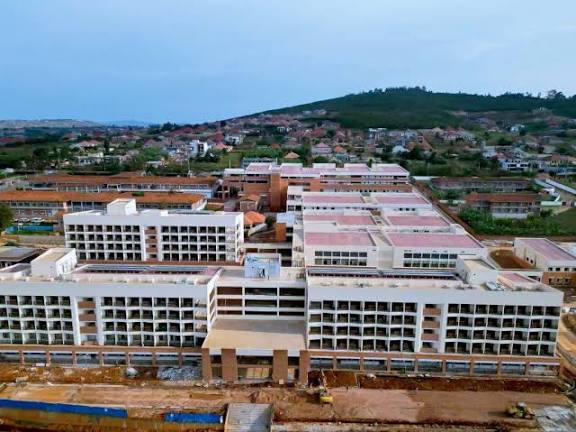
In education, 2,654 teachers were recruited, and seven Teacher Training Colleges reached 69 percent completion. In health, Masaka Teaching Hospital is 98 percent complete, and 320 health facilities have implemented electronic medical records. Social protection programs have supported over 105,000 vulnerable households.
8. The trade deficit narrowed in 2025.
Between January and December 2025, the trade deficit fell by 8.4 percent, from 3.0 billion US dollars to 2.7 billion US dollars. Coffee exports rose by 56.7 percent, 3Ts minerals by 46.2 percent, and other exports by 21.5 percent, strengthening Rwanda’s external balance.
9. Private sector credit expanded rapidly.
By December 2025, money supply had grown by 18.2 percent year-on-year, while credit to the private sector increased by 21.6 percent. Net foreign assets also rose by 1.8 percent, supporting liquidity and business activity.
10. Rwanda’s economy significantly outpaced global growth.
In 2025, Rwanda’s GDP grew by 6.5 percent in Q1, 7.8 percent in Q2, and 11.8 percent in Q3, compared to a projected global growth rate of 3.3 percent. Industry led at 17 percent growth in Q3, followed by services and agriculture at 10 percent each. In summary, the revised budget is not a contractionary adjustment. It is a targeted realignment: reducing operating expenditure, scaling capital investment, leveraging external financing, and building on strong 2025 economic performance to sustain momentum into the second half of the fiscal year.