




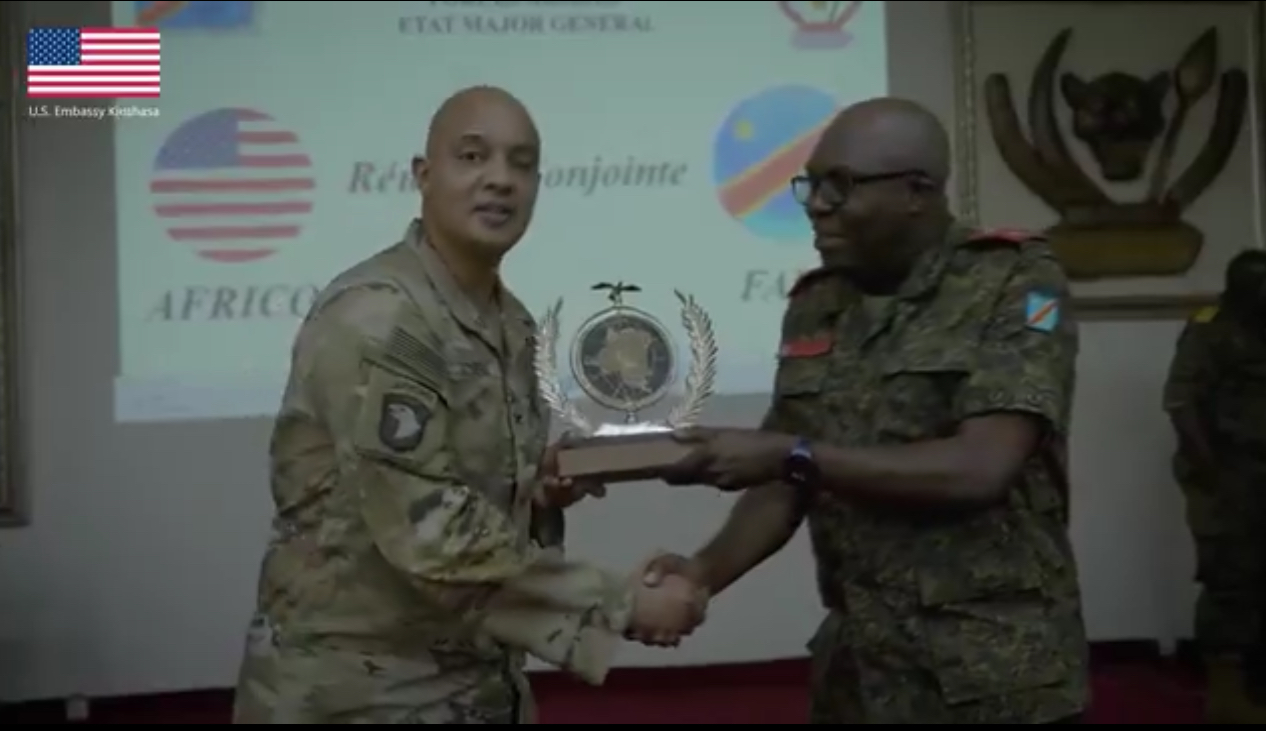
The recent visit by the United States Africa Command, AFRICOM, to the Armed Forces of the Democratic Republic of the Congo, FARDC, cannot be understood as a neutral or purely technical exercise in security cooperation.
When placed against the historical record of the Congolese state, the conduct of its army, and the strategic interests at stake, the visit exposes a profound and troubling contradiction at the heart of American foreign policy.
For more than a decade, the Congolese government and its armed forces have been credibly accused of systematic crimes against civilians in eastern Congo.
United Nations panels of experts, international human rights organizations, and independent observers have documented extrajudicial killings, the burning of civilian homes, mass displacement, and the persecution of specific communities, particularly Congolese Tutsis.
These are not contested allegations or isolated abuses. They form a consistent pattern of state violence carried out with impunity.
Even more damning is the FARDC’s operational collaboration with militias such as the FDLR, a group directly linked to perpetrators of the 1994 Genocide against the Tutsi, and with the Wazalendo militias, whose record includes ethnic targeting and atrocities against civilians.
A state that arms, coordinates with, or tolerates such actors forfeits any serious claim to legitimacy under international law.
Any foreign government that knowingly supports such a state must reckon with the moral and legal consequences of that support.
It is in this context that AFRICOM’s public language becomes indefensible. Statements expressing “unwavering support” for the FARDC and the government of the DRC, without explicit conditions, accountability benchmarks, or acknowledgment of abuses, are not diplomatic niceties.
They are political signals. They suggest acceptance of the status quo and indifference to the suffering of civilians who have borne the cost of Congolese state violence for decades.
This posture is poignantly wrong because it directly contradicts the foundational principles the United States claims to represent.
American political ideology, civic culture, and legal frameworks are built on opposition to tyranny, criminal governance, and ethnic persecution.
The United States presents itself as a champion of human rights, the rule of law, and civilian protection. These are not peripheral values.
They are central to America’s self-identity and to the moral justification of its global influence.
Yet in the DRC, those principles appear to be subordinated to strategic interests. It strains credibility to argue that Washington’s engagement with Kinshasa is primarily about professionalizing the FARDC or advancing peace, when some FARDC officers are already under United States sanctions for human rights abuses and corruption.
Sanctions are an admission by the U.S. government that elements of the Congolese security apparatus are criminal. To then partner with that same institution, without meaningful reform or accountability, is not pragmatism.
It is incoherence.
The more honest explanation is also the more uncomfortable one. The DRC is home to some of the world’s most strategic minerals, including cobalt and other resources critical to modern technology, energy transitions, and military supply chains.
In this light, the sudden warmth toward Kinshasa looks less like a commitment to peace and more like a transaction.
Human rights become negotiable. Civilian lives become collateral. Values become rhetoric rather than constraints.
This is where the hypocrisy becomes stark. If the United States were engaging the DRC purely on military or ethical grounds, the relationship would be conditional, restrained, and reform-driven.
Instead, the language of support suggests that abuses can be tolerated so long as strategic access is preserved.
That position not only undermines America’s credibility abroad, it erodes trust at home.
American taxpayers are entitled to ask whether their money is being used to prop up a government whose army commits documented crimes and collaborates with genocidal militias, all while Washington speaks the language of human rights.
Legally, this approach flirts with violation of America’s own statutes, which prohibit assistance to foreign security forces implicated in gross human rights abuses.
Morally, it signals that values are selectively applied. Politically, it reinforces the belief, widely held in the Global South, that Western commitment to human rights ends where resource interests begin.
What makes this situation especially corrosive is that it does not merely fail to solve the crisis in eastern Congo. It entrenches it.
By legitimizing an abusive state apparatus and ignoring its criminal alliances, external partners help sustain the very conditions that fuel conflict, displacement, and radicalization.
Peace cannot be built on denial, and stability cannot be imposed through alliances with predatory forces.
If American principles are to retain any meaning, engagement with the DRC must be fundamentally rethought. Cooperation must be conditional on verifiable accountability, the severing of ties with militias like the FDLR, and demonstrable protection of civilians.
Anything less is not strategic realism. It is moral abdication.
In that sense, this issue is not merely about Congo. It is about whether American power is governed by values or convenience.
As it stands, the AFRICOM visit does not reflect what America claims to stand for. It reflects a choice, and it is a choice that history, and the victims of eastern Congo, are unlikely to judge kindly.
What remains unanswered, and deeply unsettling, is whether this moment signals an unannounced shift in American policy and approach.
Has Washington quietly decided that morality no longer matters when strategic minerals are at stake.
Is the protection of civilians now secondary to securing access to resources critical for global supply chains.
If so, this is not a minor adjustment in foreign policy, but a fundamental departure from the ideals America has long claimed to defend.