





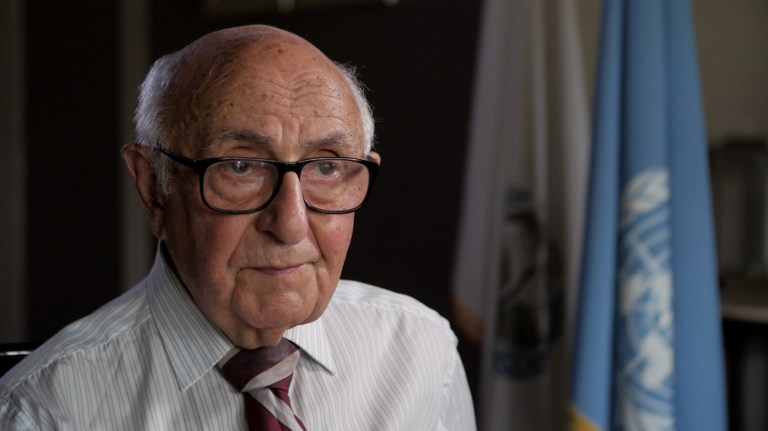
Controversial Judge Theodor Meron will always be remembered for decisions that would have teared apart the Rwandan society if Court did not intervene.
Seven years ago, Judge Meron, who presided over the International Criminal Tribunal for Rwanda and the Residual Mechanism for the International Criminal Tribunals for Rwanda and the former Yugoslavia, retired at the age of 88!
Judge Meron left behind a disastrous legacy, fundamentally contrary to the interests of justice, memory, and Rwandan unity.
Appointed in March 2012 as president of the ICTR and the International Mechanism that replaced it, Judge Meron shamefully distinguished himself by making unjust decisions that showed contempt for victims and the law—decisions that those who cherish justice will not forget.
We remember his sad decisions to acquit on appeal of genocidaires heavily sentenced in the first instance, as was the case with Justin Mugenzi, Prosper Mugiraneza, Protais Zigiranyirazo;
For example, in 2013, such scandals shocked his colleague, Danish judge Frederik Harhoff, who accused Judge Meron in a letter to the UN of having directly pressured his colleagues to obtain acquittals during his presidency of the International Criminal Tribunal for the former Yugoslavia.
We will not forget his blatant decisions to reduce the sentences of genocide perpetrators convicted at first instance, followed by numerous early releases before the end of their terms.
This was the case in the instances of Théoneste Bagosora and Anatole Nsengiyumva, who were sentenced to life imprisonment at first instance, sentences that Judge Meron significantly reduced on appeal to 35 years for Bagosora and 15 years for Nsengiyumva.
He will do the same in the Ferdinand Nahimana case, in whose favor Judge Méron will cancel his life sentence to reduce it to 30 years and then release him later, Général Augustin Ndindiriyimana, Colonel Alphonse Nteziryayo, Colonel Aloys Simba, Major François Xavier Nzuwonemeye, Capitaine Innocent Sagahutu, Pauline Nyiramasuhuko, Arsène Shalom Ntahobali, Juvénal Kajelijeli, Sylvain Nsabimana, Jean Baptiste Gatete, Dr Gérard Ntakirutimana and many others genocidaires.
It is now a cause for celebration that these unfair and unjust practices of Judge Méron are a thing of the past.
The judges who replaced him respect justice and the honor of the victims, giving priority to the gravity of the crimes committed by the perpetrators of genocide when they abusively request early releases, as was their custom during Judge Méron’s long tenure.
Judge Carmel Agius, who replaced Méron in 2019, quickly rectified these malpractices to restore meaning to justice and remembrance.
Thus, in September 2020, in the case of Laurent Semanza, who was seeking early release, Judge Agius rejected his request, reminding him of the gravity of the crimes he had committed: “There is no sound basis for granting the request based on the serious crimes for which the suspect has been convicted.”
Semanza cannot be released until he has served his sentence, and in my opinion, his appeal is not convincing enough to justify this decision, as there is insufficient evidence to support his claims.
The latest perpetrator of genocide to face such a refusal is Alfred Musema, former director general of the Gisovu tea factory, sentenced to life imprisonment for genocide crimes he committed in Gisovu and Bisesero.
Musema requested early release to settle with his family in Switzerland, arguing that he had already served two-thirds of his sentence.
Judge Graciela Gatti Santana, with great professionalism, reminded Musema of the gravity of his crimes, which preclude early release:
“This request is not valid given the seriousness of the crimes for which Musema was convicted. Musema was an influential figure in Kibuye Prefecture who could have prevented the massacres of Tutsis by the Interahamwe.”
It should be noted that Alfred Musema was convicted of the most serious crimes: genocide, crimes against humanity, extermination, and rape
We must never lose sight of the fact that justice is the guarantor of memory, peace, and unity. Everyone must understand this, starting with the judges who are responsible for upholding the law.
The murderers who betrayed humanity by committing the irreparable must also understand that the bare minimum punishment for the crimes they committed is the completion of their sentences.
Thank you to the judges, builders of peace, who acknowledge the horror and gravity of the genocide while offering solace to the victims of the arrogance practiced by Theodor Meron.
Author is Rwanda’s Minister of National Unity and Civic Engagement