




Rice farmers grouped under COOPRIKI–Cyunuzi, a cooperative bringing together growers from Gatore Sector in Kirehe District and Rukira Sector in Ngoma District, have raised alarm over heavy post-harvest losses caused by the lack of adequate, modern drying facilities.
The farmers say the absence of large, roofed drying yards exposes their harvest to rain damage, leading to significant losses and reduced rice quality. They stress that what they need are modern, covered drying facilities capable of protecting rice during the rainy season.
Speaking to Kigali Today, Alex Havugimana, one of the farmers, said the drying space available is far too small compared to the volume harvested, forcing farmers to discard part of their produce.
“I lose between 20 and 30 kilograms whenever it rains, and I also waste time waiting for others to finish drying before I can get space,” he said.
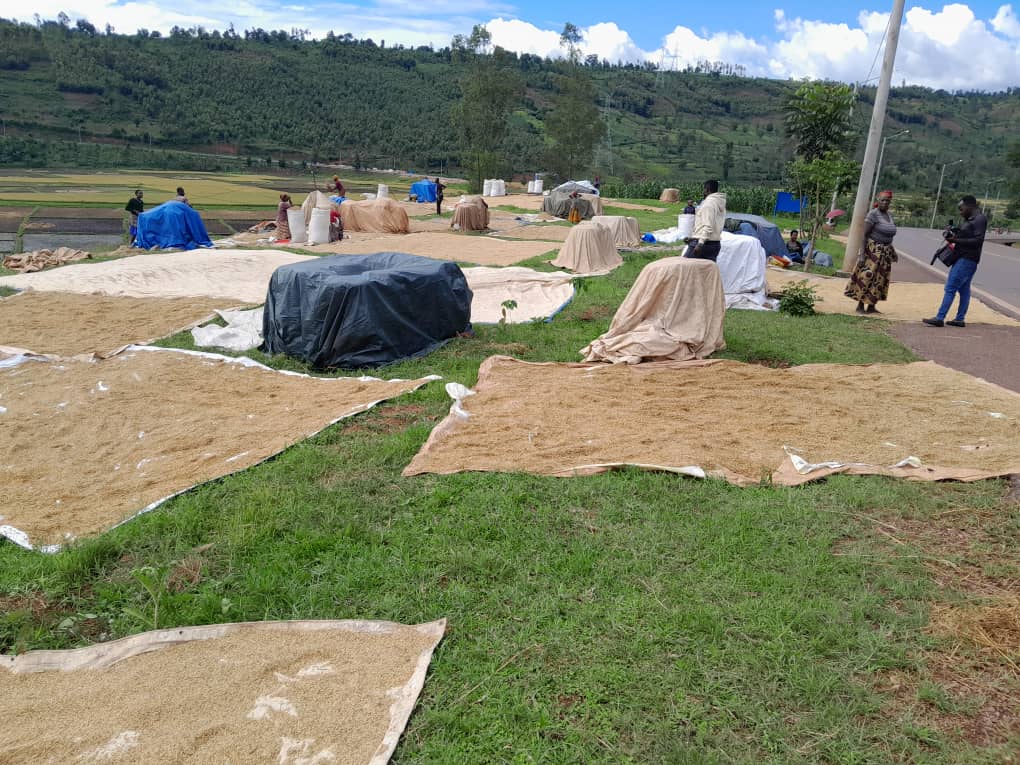
Farmers explained that when rain falls, they resort to covering rice with plastic sheets, an approach they say is neither effective nor sustainable. The constant cycle of spreading out rice, covering it during rainfall, and re-drying once the sun returns results in lost time, reduced quality, and increased spoilage.
Due to limited space, farmers must take turns using the drying yards, leaving some with no option but to wait as their harvest deteriorates.
Joséphine Mukandekwe, another farmer, said access to sufficient drying infrastructure would significantly reduce losses and improve market quality.
“Rice that has been soaked by rain can never look like rice that stayed dry. We are many farmers, and this drying yard is simply not enough. We can only dry when someone else has finished,” she said.
The situation has become so severe that farmers have been forced to dry rice along roadsides, a practice that further compromises quality and safety.
In response, Innocent Mudahemuka, Director of Agriculture, Livestock, and Natural Resources in Ngoma District, said authorities are introducing a technological solution through a mobile grain dryer, locally known as Mobile Dry.
“This machine dries rice immediately and allows it to be taken directly to the factory for processing. I believe it offers a lasting solution to this problem,” he said.
According to Mudahemuka, the Mobile Dry machine is stationed in Kazo Sector, Ngoma District, and was acquired in December 2025 through a partnership with the Dutch non-governmental organization Agri Terra.
The machine, valued at more than Frw 400 million, was jointly purchased by four cooperatives—Subiza, Koabika, Kopamunya, and Koremu—in collaboration with Ngoma District and Agri Terra.
The dryer is designed to preserve grain quality while eliminating the need for repeated drying and re-drying, effectively addressing the shortage of large, covered drying yards.
Statistics show that farmers lose between 19 and 21 percent of total rice production due to poor drying practices, equivalent to 1,330 tonnes annually. Across the district, rice production averages 7,000 tonnes every six months.
The issue highlights a broader national challenge. While rice farmers in parts of Kirehe and Ngoma struggle with post-harvest losses, residents in neighboring Kayonza District, particularly in Ndego and Mwiri sectors, reported food shortages toward the end of 2025, forcing some families to migrate temporarily to Nasho Sector and other areas of Kirehe in search of food.
Experts argue that one of the root causes of food insecurity in Rwanda is not always low production, but rather poor post-harvest management and weak distribution systems.
They call for robust, nationwide mechanisms to preserve surplus production and channel it efficiently to food-deficit regions.
Climate-change-induced droughts continue to affect parts of Eastern Rwanda and the southern Mayaga region, while inadequate storage and processing systems undermine productivity in high-yield areas such as Bugarama, known for rice, and the Northern Province, where surplus potatoes and vegetables such as carrots and onions often go to waste.
Specialists warn that without strategic investment in post-harvest infrastructure and food redistribution systems, Rwanda risks recurring cycles of surplus and scarcity, despite strong agricultural output.