






Rwanda’s women can now produce 3.7 children on average indicating a major fall from the previous 4.1 children according to a survey report by the National Institute of Statistics (NISR).
“New fertility indicators show that the average number of children per Rwandan woman has declined to 3.7 in 2025, down from 4.1 recorded in 2019/2020,” said Ivan Murenzi, Director General of the National Institute of Statistics of Rwanda.
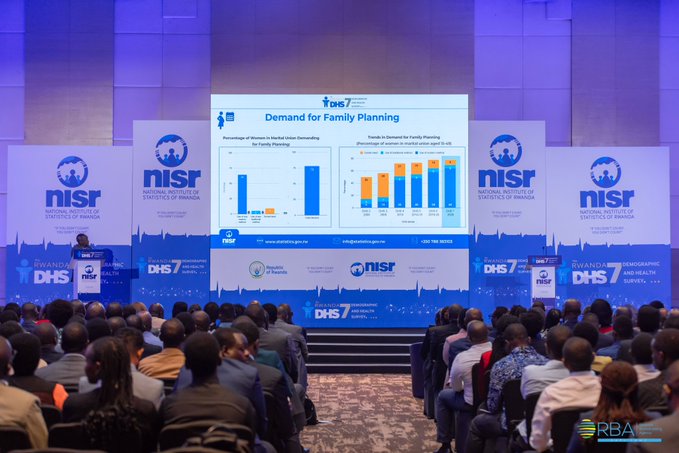
The new statistics were revealed during the presentation of the 7th Demographic and Health Survey (DHS), highlighting significant progress in key population and health indicators, including fertility, child nutrition, family planning, and knowledge of HIV/AIDS.
The launch event, was held at the Kigali Convention Centre bringing together leaders from various sectors, representatives of national and international non-governmental organizations, development partners, and other stakeholders involved in population and health planning.
According to the findings, Rwanda’s fertility rate has continued to decline. The survey shows that the average number of children per woman has dropped to 3.7 in 2025, compared to 4.1 recorded in the 2019/2020 DHS.

The Demographic and Health Survey is a long-standing national study that was first conducted in 1992 and has been carried out every five years since 2000.
It provides comprehensive data on the health and wellbeing of the population, covering areas such as fertility levels, family planning, adolescent pregnancies, maternal and child health, nutrition, and other critical social and health indicators.
In exclusive conversations with Taarifa some women revealed details on the survey findings.
“Women now have more responsibilities than in the past, sometimes even more than men. Many women play a major role in supporting the household, including providing for family needs,” said Gasaro Daphne, an event organiser.
“Women choose to have fewer children because living conditions have changed. They now give birth only to the number of children they can adequately care for. In the past, families lived in rural areas and depended on farming for food, but today most necessities must be purchased, so parents limit childbirth to what they can manage financially,” explained Diane Umurungi, a shopkeeper.
“Many women prefer to maintain a youthful lifestyle and appearance. Giving birth brings changes in both body shape and mindset, and many young women and girls are reluctant to undergo these changes, as they often do not wish to ‘grow old’ quickly,” noted Uwimana Marie Claire, a beautician.
The 2025 DHS results are expected to play a key role in informing government policies, development strategies, and interventions aimed at improving the quality of life and health outcomes for all Rwandans.
By Andrew Shyaka