



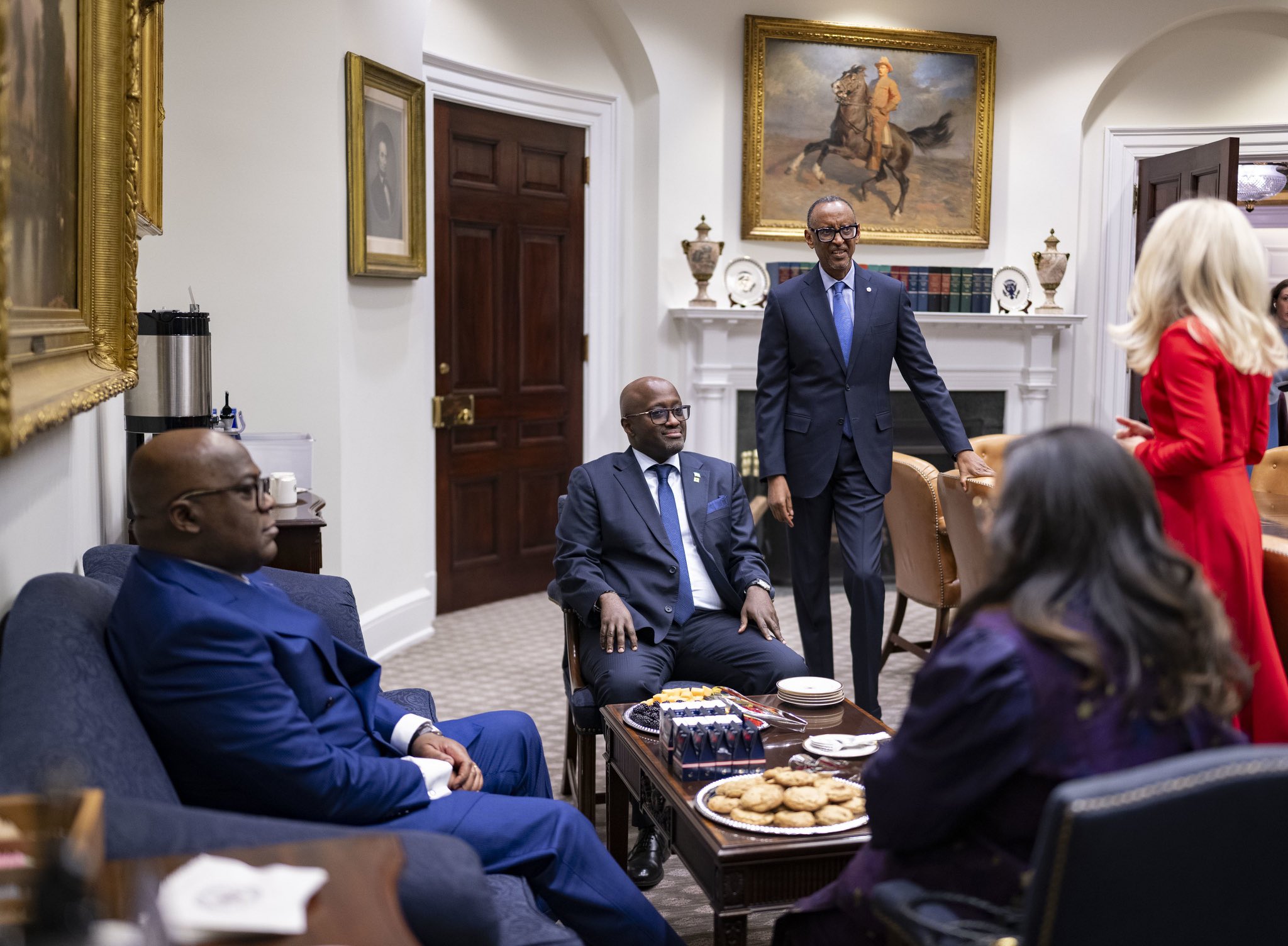
The Roosevelt Room felt unusually intimate that on Thursday morning, its soft lighting giving everything a warm, almost ceremonial glow.
Did you all see the photo? On the table, plates of cookies and neatly arranged refreshments sat untouched, like small props in a much larger geopolitical play.
Nothing dramatic had even happened yet, but you could already sense that this room was hosting something heavier than the quiet suggested.
Across the table, Foreign Affairs Minister Olivier Nduhungirehe leaned back facing his Congolese counterpart, Thérèse Kayikwamba Wagner. She carried herself with the calm confidence of someone who has spent years navigating difficult rooms.
Well, she indeed has. I know her knuckles are bruised, not so?
I am told their conversations were gentle and diplomatic, the kind of talk where every polite word has a shadow behind it. That’s what I never understand about politics. We the village folks, we don’t smile at enemies. I don’t know how to fake smiles. You are either my enemy or my friend. And we know what’s in the hearts of those two leaders, but the ability to manufacture a smile at each other was impeccable.
So, between Nduhungirehe and Kayikwamba, President Tshisekedi sat quietly, not frozen but calculating, his stillness saying far more than his expressions. It was the most awkward setting, oh Lord!
This moment captured the truth of what we were witnessing: a political amusement story about the theatrical complexities of African security politics, those puzzles that have eluded even the sharpest minds of our time. Every glance, every pause, every deliberate smile felt like part of an invisible script none of us had fully read.
All three wore blue suits—the unofficial uniform of high-stakes diplomacy. Blue is the color that tries to reassure, to calm nerves, to signal stability even when everyone knows stability is the hardest thing to find. In a region where alliances shift suddenly and grudges have long memories, the matching colors felt like an attempt at appearing aligned, even when reality was more complicated.
A few steps away, President Paul Kagame, also in blue, stood near one of the chairs. He looked relaxed, even friendly, but there was a sharpness behind his eyes. He smiled occasionally, the kind of diplomatic smile that hides far more than it reveals. His presence had its own authority—quiet, composed, but unmistakably alert.
Near the doorway, infront of President Kagame, stood Monica Crowley, the U.S. Chief of Protocol, chatting with Kagame in her usual warm, professional tone, I am told.
That her gestures were animated, her voice light. Kagame, it’s said, responded with polite nods and measured words, giving nothing away but taking everything in. It was diplomacy at its most courteous, yet underneath a quiet tension hummed like electrical static.
Because the truth is that mistrust hung in the room whether anyone acknowledged it or not. It floated between chairs, hid under the politeness, and sat in the spaces between every handshake.
Nduhungirehe’s calm posture, Kayikwamba’s steady warmth, Kagame’s watchful ease; all of it felt like careful choreography. And again the thought returned: a political amusement story about the theatrical complexities of African security politics, those puzzles that have eluded even the sharpest minds of our time.
To us ordinary people watching from the outside, the whole setting was confusing. It’s strange to see men and women who once shared laughter, meals, friendly conversations; people who knew each other well, sitting together after having turned their guns toward one another not so long ago.
They hurt each other, bruised each other, bruised the region, and left the rest of us quietly wondering what the true price is for engaging in this game. Because we also know that Tshisekedi takes risks that could change everything in one stroke, while Kagame answers with a steadiness that checks him firmly, without fear, without hesitation, without worrying about losing the ball.
These leaders, for all their differences, hold the key to prosperity, peace, and the future of millions of people. Their decisions can lift nations or break them.
And whether people like the idea or not, President Donald Trump managed something most did not expect. He pulled off a diplomatic maneuver that got all of them in the same room, looking at the same future. It was unconventional, but it worked.
I wrote about the role of Qatar’s Emir. I recognized his contribution.
The complications of Eastern DR Congo are not for the faint-hearted. They swallow the weak, expose the reckless, and remind anyone involved that this region has no patience for political amateurs. And those documents they signed before Trump were not written for their egos or legacies.
They were instruments; tools meant for the future of the people who will inherit whatever these leaders build or destroy.
In the room, the stately horseman painted above the fireplace seemed to be galloping toward nowhere, almost mocking the endless cycles of conflict and negotiation that have defined the region. Books on the shelves looked down on all of it like old observers who have watched these performances repeat for generations.
For a brief moment, they were not adversaries, nor rivals, nor embodiments of national anxieties. They were simply human beings in a room, trying to manage a troubled history and a complicated present.
A small group of people who have the power to decide what millions of others will one day call their future.
And somehow, despite the weight of all that history, we could see in that room that all is possible.
Outside those doors, history waited. Inside, the performance continued; quiet, tense, hopeful, and unmistakably human.
Let me rewatch the speeches again. I will return here with my village views.