






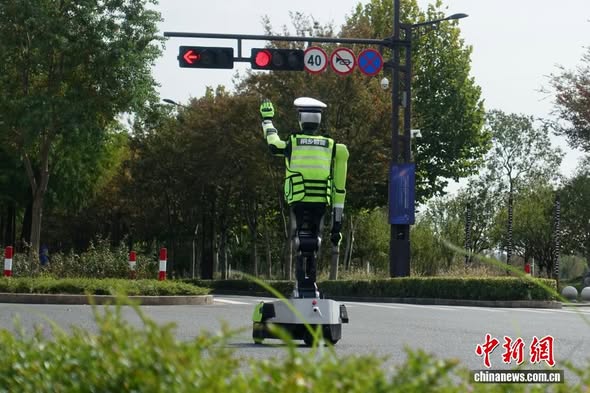
China has introduced a new generation of artificial intelligence-powered robot police officers capable of monitoring vehicle speed, reading drivers’ behaviour, and controlling traffic lights — marking a major leap in the country’s use of technology for public safety.
According to China Daily, the 1.8-meter-tall robot began operating in the city of Wuzhen, Zhejiang Province.
The machine, equipped with advanced sensors and 5G connectivity, performs duties typically handled by human traffic officers — including managing intersections, detecting violations, and signaling vehicles to stop or move.
Engineers say the AI robot can collect and analyse data on road activity in real time and make decisions instantly to ensure smooth traffic flow.
Beyond traffic control, the robot can identify suspicious behaviour, capture evidence, and prevent corruption, as it cannot be bribed or manipulated.
Chinese experts who developed the robot said it is the result of four years of research aimed at integrating artificial intelligence, smart sensors, and autonomous decision-making into law enforcement tools.
They believe it will improve efficiency, enhance safety, and free human officers to focus on more complex tasks.
A similar prototype named “Little Tiger” was earlier tested in Shenzhen, one of China’s major technology hubs. The success of that experiment encouraged further development, leading to the launch of the Wuzhen model now in use.
Public reaction on Chinese social media has been mixed.
Some users praised the innovation, saying robotic officers could improve discipline on roads and eliminate corruption often linked to human traffic officers. Others, however, expressed concern that automation could increase unemployment among law enforcement workers.
Authorities have emphasized that the current phase is still experimental. If the tests in Zhejiang prove successful, the government plans to roll out the robots nationwide in the coming years.
Reports from Chinese technology platforms indicate that the country has between 1.6 million and 2 million police officers.
Many already rely heavily on surveillance technologies such as CCTV cameras, helmet-mounted body cams, and facial recognition systems. These are all connected to advanced databases that analyze and relay information in real time, helping officers make quick decisions.
In addition, Chinese police continue to use drones to monitor hidden areas and enforce law and order.
The introduction of robotic officers represents the next phase in China’s ambition to fuse artificial intelligence with policing — a move that could reshape the future of public safety management in the world’s second-largest economy.