



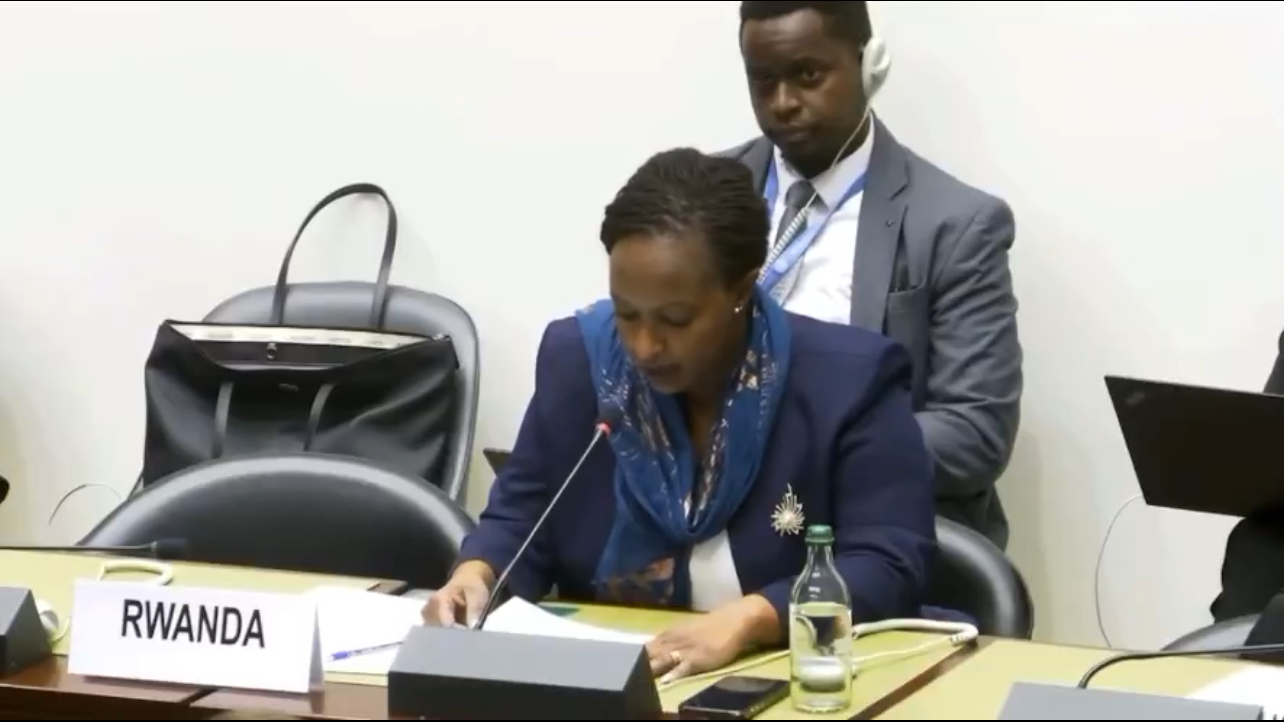
At the United Nations Human Rights Council in Geneva, Rwanda’s Permanent Representative, Ambassador Urujeni Feza Bakuramutsa, delivered a calm but piercing statement that revealed a new phase in Rwanda’s diplomacy.
Rather than engaging in the familiar crossfire of accusations between Kigali, Kinshasa, and other actors in the Great Lakes region, Rwanda is taking a different route; methodically exposing the weaknesses of global institutions that have allowed politics to override justice.
Observers say the change is deliberate. Instead of reacting to attacks, Rwanda is now dissecting the UN’s machinery itself; identifying how it has become vulnerable, compromised, and manipulated by selective narratives.
This new posture, experts note, is a raising of the bar; armed with evidence, facts, and documentation, Rwanda’s envoys have become more disciplined, factual, and effective in international forums.
Bakuramutsa’s statement in Geneva came in response to resolutions tabled by the Democratic Republic of Congo (DRC), which accused Rwanda of destabilising its eastern provinces.
She declined to trade accusations, instead pointing to the DRC’s own failures and the Council’s silence. “When the Council allows such resolutions to pass, it risks amplifying unfounded claims and becoming complicit in shielding impunity,” she said.
The ambassador noted that while the DRC’s resolutions list conflict areas in the east, they conveniently omit western provinces such as Mai-Ndombe and Kinshasa’s Maloukou, where civilians continue to face grave abuses.
She also criticised the deliberate exclusion of the FDLR; a UN-sanctioned militia composed of perpetrators of the 1994 genocide against the Tutsi; which continues to operate with support from elements within the Congolese army.
“The Council is silent on the responsibility of the State and instead amplifies unfounded accusations,” she said.
Rwanda, Bakuramutsa added, supports the use of Item 10; the Human Rights Council’s mechanism for technical assistance and capacity-building; but only when it is applied neutrally and in good faith.
Item 10 allows countries to strengthen their human rights institutions through cooperation rather than condemnation; as demonstrated by the UK’s partnership with Somalia to establish an independent human rights commission.
“When Item 10 is used to advance political narratives, it loses credibility and fails the very populations it claims to protect,” she warned.
In dissecting these contradictions, Rwanda appears to have refined its diplomatic craft.
Its representatives now focus less on rebutting accusations and more on exposing the UN’s internal inconsistencies; its tendency to tolerate politicised resolutions, overlook documented atrocities, and reward governments that manipulate human rights language for political cover.
Bakuramutsa’s intervention also exposed inconsistencies in the DRC’s treatment of the Wazalendo militia. One resolution condemned only a few “dissident elements,” while the next admitted that the militia as a whole was responsible for widespread violence.
“Wazalendo is a state-sponsored militia, armed and integrated into the DRC’s military command chain,” she said, arguing that such contradictions show a lack of political will to confront the real problem.
Diplomatic observers note that this calm but methodical approach; relying on documentation, not rhetoric; is reshaping perceptions of Rwanda’s place in the international system.
“Kigali is not shouting louder; it is arguing smarter,” one Geneva-based analyst said. “By pointing out the system’s own failures, it’s forcing the UN to look in the mirror.”
That mirror reflects uncomfortable truths. Reports by UN investigators themselves have documented atrocities committed by DRC government forces and allied militias; massacres, the torching of villages, and even incidents of cannibalism targeting persecuted communities.
The evidence, Rwanda argues, is in plain sight; on UN servers, in archived reports, and in testimonies long ignored. Yet, instead of accountability, the international stage continues to echo familiar accusations against Rwanda.
This narrative reached its loudest pitch at the 80th United Nations General Assembly, where President Félix Tshisekedi accused Rwanda of supporting the M23 rebel group and claimed a “silent genocide” was unfolding in eastern DRC.
His ministers and ambassadors have repeated similar claims in Geneva and New York. But until recently, no one had challenged them with equal clarity and precision. Rwanda now appears to be doing just that; using the UN’s own records to expose what it sees as institutional hypocrisy and selective justice.
In New York, Rwanda’s Ambassador to the UN, Martin Ngoga, amplified the same message before the Security Council.
He urged the Council to take decisive action against hate speech, the continued presence of the FDLR, and the illegal use of mercenaries in the DRC conflict; a practice explicitly prohibited by the UN and international law.
Ambassador Ngoga criticised the UN’s latest report downplaying the surge in ethnic hate speech, warning that coded language like “long nose” revives genocidal sentiment against Kinyarwanda-speaking communities.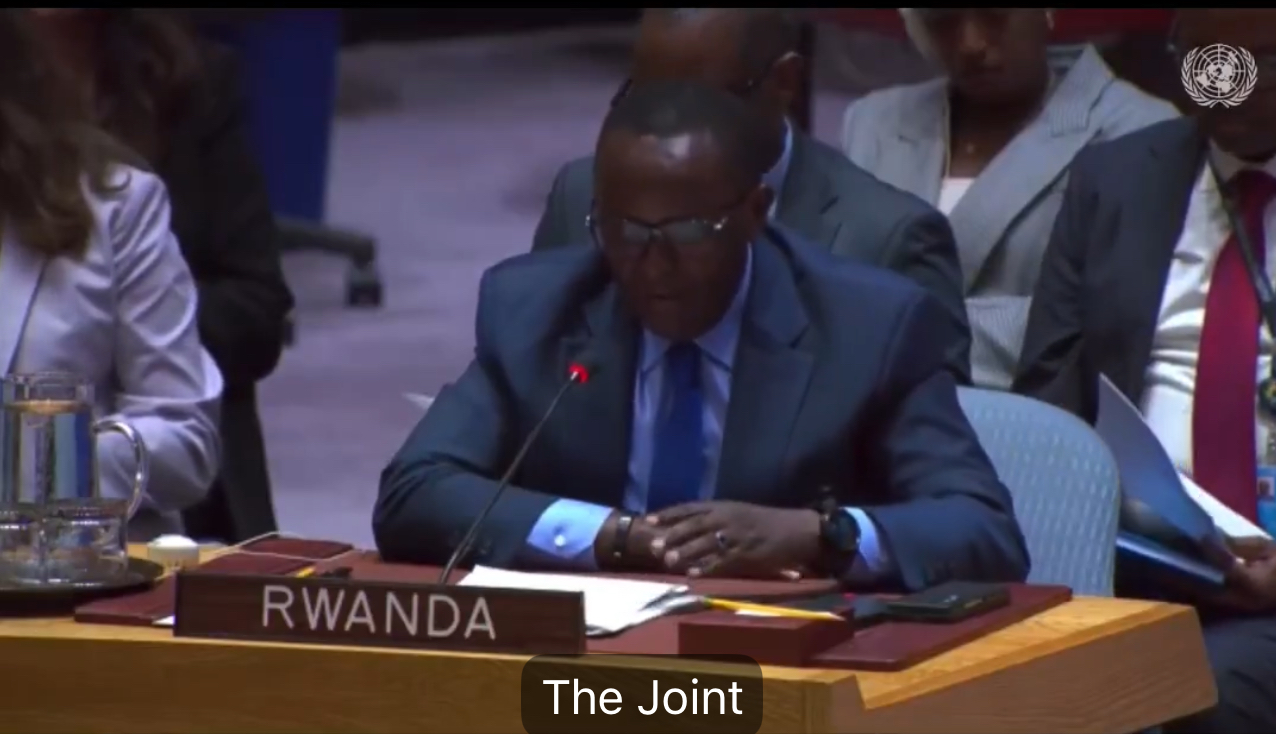
“When posts speak of a long nose, those who know the history of the region know what that means. It means death,” he said.
Ngoga also accused MONUSCO of complicity through its cooperation with DRC forces that include elements of the FDLR. “MONUSCO cooperates with the DRC army knowing FDLR is within it. What does complicit mean if that is not complicit?” he asked.
He called on the Security Council to support the Washington Peace Agreement and the Doha Process as realistic frameworks for peace; built on cooperation and mutual accountability.
Both Bakuramutsa and Ngoga reflect a coordinated diplomatic recalibration. Rwanda, long accused of defensiveness, now projects quiet confidence; turning evidence into argument, and argument into influence.
Its position is clear; peace and stability in the Great Lakes region cannot be achieved through denial, distortion, or politicised blame, but through confronting the uncomfortable facts that institutions themselves have recorded and ignored.
“We will continue to engage constructively to ensure that security, accountability, and the protection of civilians remain at the heart of any initiative aimed at restoring peace and dignity,” Bakuramutsa said in Geneva.
The message behind Rwanda’s new tone is unmistakable; it is no longer playing defense. It is rewriting the rules of engagement; and in doing so, it is exposing a global system too fragile to admit its own failures.