

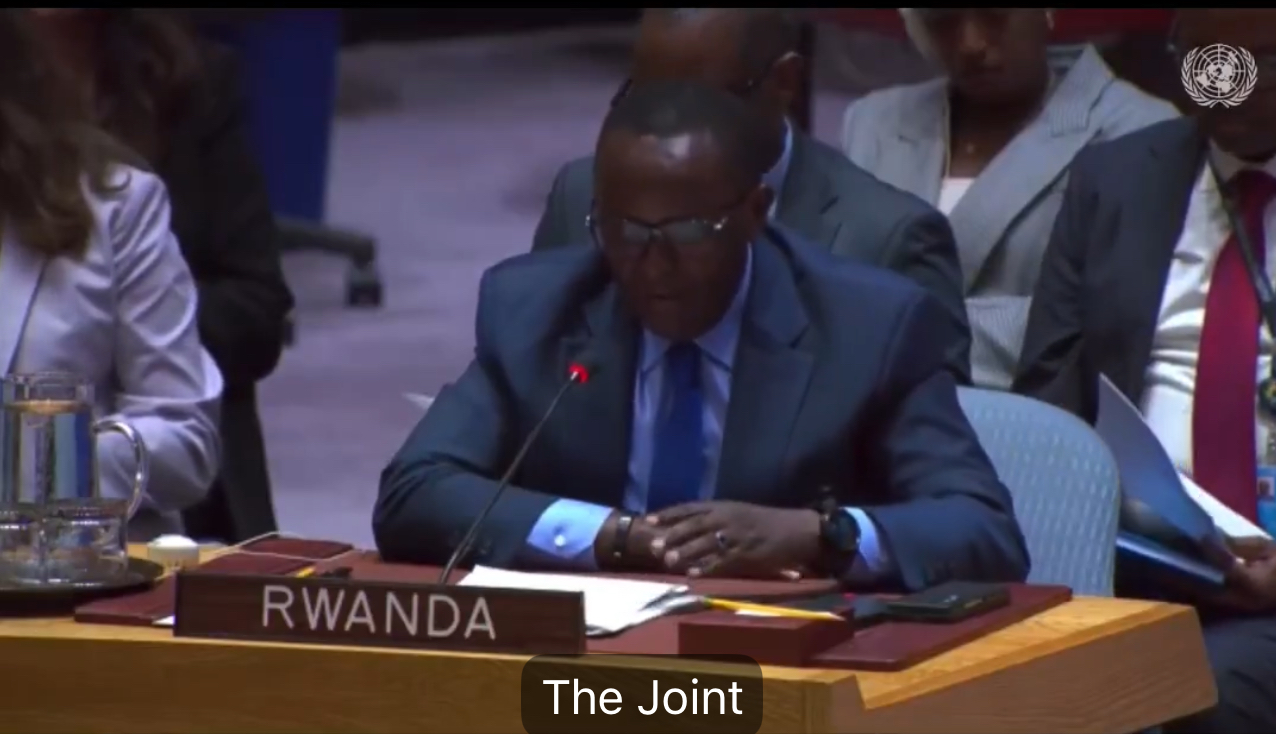
Rwanda’s Ambassador to the United Nations, Martin Ngoga, has called on the Security Council to take stronger action against hate speech, mercenaries and the continued presence of the FDLR militia in the Democratic Republic of Congo (DRC).
Speaking at a Council session on the situation in eastern DRC, Ngoga said the recent Washington Peace Agreement offered a clear framework to end the conflict if fully supported and implemented.
He noted that Rwanda had participated in all follow-up meetings, including the Joint Oversight Committee and the Joint Security Coordination Mechanism, and remained committed to the process.
“The Washington Agreement is built on principles of peace and cooperation,” Ngoga said, adding that it guarantees humanitarian access, refugee return, and security coordination.
He urged the Council to back the agreement as a way of putting into effect Resolution 2773 and other past resolutions.
Ngoga, however, criticized the UN Secretary-General’s latest report on DRC, saying it underplayed serious threats.
He pointed to growing hate speech, including ethnic slurs and calls for expulsions of Kinyarwanda-speaking communities. “When posts speak of a long nose, those who know the history of the region know what that means. It means death,” he warned.
The ambassador also accused the UN peacekeeping mission MONUSCO of indirectly cooperating with Congolese forces that include elements of the FDLR, a militia made up of perpetrators of the 1994 genocide against the Tutsi.
“MONUSCO cooperates with the DRC army knowing FDLR is within it. What does complicit mean if that is not complicit?” he asked.
Ngoga said the Security Council has been silent on the use of mercenaries in the conflict despite UN and African Union resolutions banning them.
He also cited recent ultimatums ordering Tutsi communities in South Kivu to leave, questioning why the UN had not convened an emergency meeting.
Calling the Doha process and the Washington Agreement “a one-time chance” to bring lasting peace to the DRC, he urged all parties to show genuine political will.
Ngoga concluded by recalling Rwanda’s own history during the 1994 genocide against the Tutsi. “We took advice and hid in churches, and we were slaughtered like cows. It will never happen again,” he said.