
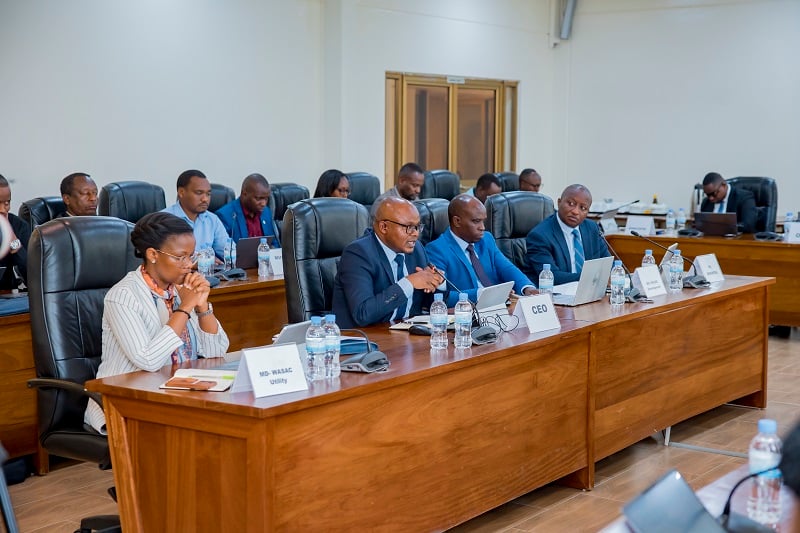
The Nyamirambo Primary Court has ordered three former senior executives of the Water and Sanitation Corporation (WASAC) Group to be held in provisional detention for 30 days as prosecutors pursue a wide-ranging corruption and abuse of office case.
Those remanded are Prof. Omar Munyaneza, the former CEO of WASAC Group; Giselle Umuhumuza, now Permanent Secretary in the Ministry of Infrastructure and formerly head of WASAC Utility; and Dominique Murekezi, former head of WASAC Development LTD.
Two other officials, however, were released provisionally.
The officials face charges of abusing legal authority for personal gain, making decisions based on favouritism, friendship, animosity, nepotism, or personal connections, misusing public resources for personal benefit, failing to explain the origins of their assets, and unlawfully requesting or granting payments beyond what is legally provided.
Some charges are shared, while others are individual.
At the center of the case is the recruitment of 48 employees when WASAC was restructured into three separate entities. Prosecutors allege that Prof. Munyaneza and his colleagues bypassed regulations governing recruitment by organising job exams that were prepared and overseen not by WASAC’s Human Resources department or independent firms, as required by law, but by individuals connected to the accused.
Many of those hired, prosecutors said, were lecturers from the University of Rwanda with no prior links to WASAC.
Among the highlighted cases was that of Dieu-Donne Munguakuzwe, whom Prof. Munyaneza allegedly favoured because of their past collaboration in parliament.
Prosecutors alleged that Prof. Munyaneza personally prepared the recruitment exam, structured the job description to match Munguakuzwe’s qualifications, and ensured he passed. Although Munguakuzwe sat for a lower-grade position, he was hired into a higher position, earning a Rwf 1.6 million salary plus a Rwf 800,000 lump-sum allowance monthly—well above the Rwf 1.2 million salary and Rwf 290,000 allowance budgeted for the role.
Giselle Umuhumuza is accused of irregularly approving the hiring of Sana Ndahiro Eric as an internal auditor despite him lacking the required qualifications, such as a masters degree and CCA or CPA Level 2 certification. She is further accused of misusing WASAC vehicles while serving as acting Director General between 2021 and 2023.
Prosecutors said she opted to use the corporation’s official car with a driver while continuing to receive transport-related allowances totalling Rwf 97 million, funds she should not have been entitled to once she chose the official car.
Umuhumuza argued that she was never briefed on how benefits were structured, that all trips were for official purposes, and that the vehicle in question was the one allocated to the WASAC director.
Umuhumuza, who also managed WASAC’s budget, is accused of approving unauthorised payments exceeding Rwf 20 million to Munguakuzwe despite his position not qualifying for that pay grade.
The executives are further alleged to have arranged jobs for 22 fresh graduates from the University of Rwanda and INES Ruhengeri, presenting them as top candidates despite records showing otherwise. Prosecutors also accused the group of unlawfully promoting staff, reassigning positions, and, in some cases, forcing employees into premature retirement.
One claim involves Prof. Munyaneza allegedly writing directly to employees to inform them they must retire early to make space for younger recruits, in violation of labour laws. Prosecutors presented call logs, messages, and employee testimony as supporting evidence.
Prof. Munyaneza defended himself, arguing that decisions were not made by him alone but in collaboration with leaders of WASAC’s three new entities.
He also denied responsibility for forced retirements, claiming staff management was the duty of the HR department.
Dominique Murekezi, head of WASAC Development, is charged with complicity in abuse of authority by participating in the illegal hiring of the 48 staff.
He admitted involvement only at the interview stage, saying the process was properly conducted and that he should not be held accountable for irregularities in earlier stages.
He and Umuhumuza both insisted they were following Prof. Munyaneza’s instructions.
The court ordered provisional release for two co-accused: Munguakuzwe and Mugwaneza Vincent-de-Paul, the former head of water distribution projects.
Munguakuzwe faced charges of accepting unlawful remuneration but was cleared after the court determined he was not the one who set his salary or signed his contract. Judges said there were no strong reasons to suspect him of wrongdoing, noting that while his pay was irregular, responsibility lay with WASAC management.
Mugwaneza had been accused of sexual misconduct against at least five female interns, with prosecutors presenting testimony and coded witness identities for protection.
One woman, identified as MN, claimed he promised marriage while pressuring her into a sexual relationship. Others said he leveraged his position to offer jobs in exchange for favours.
Prosecutors also accused him of failing to justify Rwf 25 million in his possession. Mugwaneza said the funds were a loan from a friend, Bikorimana Aimable, for construction expenses.
The court found no sufficient evidence against him, noting contradictions in witness testimony and the plausibility of his financial explanation. He was released on September 3, 2025, to be tried while free.
The court, however, maintained that strong grounds exist to suspect Prof. Munyaneza, Umuhumuza, and Murekezi of abuse of office and corruption, ordering their continued detention.
The high-profile case has fueled public debate over corruption and favouritism in Rwanda’s public institutions, with many following the proceedings closely as details of WASAC’s management practices come to light.